Search

Complete Guide to Choosing a Chess Clock

In contexts such as clubs, schools, or official tournaments, a good chess clock makes the difference between a smooth experience and one full of interruptions and discussions. At Chesscul, as a specialized chess store, we see every day that many problems in classes and competitions do not come from the game itself, but from poorly chosen clocks: difficult to set, unclear, or not very durable.

Choosing well from the beginning saves you:

  • Time lost setting up the clock before each round

  • Conflicts due to not understanding the time control

  • Money, by avoiding replacing clocks that are too basic or fragile

This guide is designed so that, whatever your profile, you know exactly which chess clock you need and why.


Which chess clock to choose according to your use

Chess clocks for beginners and home use

If you are just starting out or looking for a clock to play at home, the most important thing is simplicity:

  • Digital clock easy to set up

  • Basic time controls with increment (10+5, 15+10, etc.)

  • Comfortable buttons, especially for children

Here you do not need a tournament clock. You need one that does not get in the way of learning.

👉 Clear recommendation:

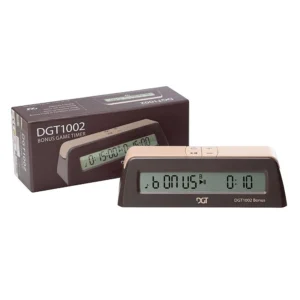
  • DGT 1002
    It is the standard budget clock. It has increment, is durable, easy to use, and perfect for learning to play with a clock from the very beginning.


Chess clocks for clubs, academies, and schools

In clubs and educational centers, the clock is used frequently, transported, handled by many people, and set up by different instructors. Here, durability and clarity are key.

What matters is:

  • Durable casing and reliable buttons

  • Simple interface, without confusing menus

  • Valid time controls for blitz, rapid, classes, and school tournaments

👉 Chesscul recommendation:

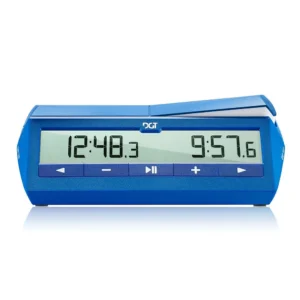
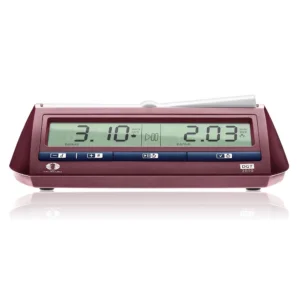
  • DGT 2010
    It is the most balanced clock for clubs and schools. Very reliable, easy to use, with increment and compatible with competition time controls. A long-lasting investment to equip classrooms or playing halls.


Chess clocks for tournaments and official competition

In tournaments the margin for error is zero. The clock must:

  • Be extremely reliable

  • Support official controls with increment and multiple phases

  • Have excellent readability

  • Be familiar to players and arbiters

👉 Recommended options:

  • DGT 2010 – standard in many tournaments

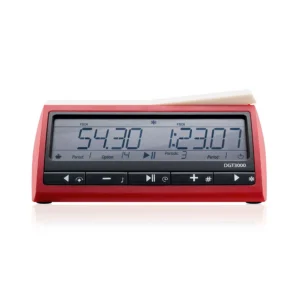
  • DGT 3000 – benchmark in high-level competitions

Using well-known clocks reduces incidents and speeds up rounds.


Premium chess clocks

If you compete, organize tournaments, or simply want the best possible clock, this is where high-end models come in.

A premium clock provides:

  • Large and very clear display

  • Quick setup of complex time controls

  • High precision and reliability

  • Better feel and stability

👉 Main recommendation:

  • DGT 3000
    The reference premium clock. Used in major competitions, extremely complete and designed for demanding players and organizers.

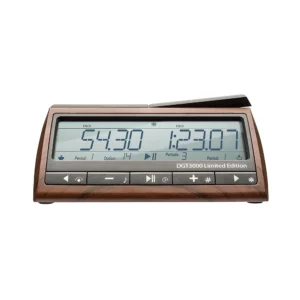
👉 Special variant:


Quick summary: which clock to choose without overthinking it

  • I’m starting to play / home → DGT 1002

  • School or club → DGT 2010

  • Official tournaments → DGT 2010 or DGT 3000

  • I want the best → DGT 3000 / Limited Edition

Frequently Asked Questions

If you are going to play tournaments, it is best to choose a professional digital chess clock, preferably FIDE-approved or similar, to ensure compatibility with standard time controls. We recommend the DGT 2010 or the DGT 3000.

For children and beginners, it is recommended to use an easy-to-use chess clock with a clear display and large buttons. A basic digital chess clock or a simple analog clock is usually enough to learn time management. Good options include the DGT 1002 or the DGT 1500.

Each model has its own menu, but the general process is similar:

  1. Turn on the digital chess clock.

  2. Select the time mode (classical, rapid, blitz, etc.).

  3. Set the initial minutes and, if applicable, the increment or delay.

  4. Confirm the settings and place the clock next to the board, with the correct side facing the player with the white pieces.

Many clocks allow you to save presets so you don’t have to configure everything from scratch every time you play.

Besides basic time counting, it is useful for your digital chess clock to include:

  • Increment (bonus time) per move.

  • Delay mode, useful in some tournaments.

  • Several preconfigured modes for different time controls.

  • Sound on/off options for alarms.

  • Durable buttons and an easy-to-read display.

The more features it has, the more versatile it will be for clubs, schools, and players of different levels.

Yes. There are affordable chess clocks that offer all the essential basic functions: countdown, count-up, and in many digital models, even increment. They are a good option for someone buying their first chess clock or for schools and clubs that need multiple clocks with a good value-for-money ratio without exceeding their budget. The standard affordable model is the DGT 1002, which you can find in our store.

Yes. A good digital chess clock allows you to configure different time controls, from blitz and rapid games to long classical games. You simply choose the appropriate time mode (for example, 3+2 for blitz, 10+5 for rapid, 90+30 for classical) and save your favorite settings.

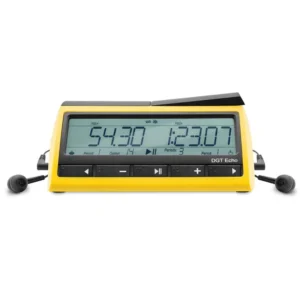
Yes. There are talking chess clocks designed specifically for blind or visually impaired players. They announce the time and move changes by voice and usually include Braille keys and clear audio signals. The most popular model is the DGT Echo.

Chess clocks for home use are usually simpler and more affordable, suitable for casual games. A professional tournament chess clock is designed for clubs and competitions, offering more time modes, greater precision, more durable materials, and often official certification for competitive play.

There are two main types of chess clocks: digital and analog. Digital chess clocks allow precise time configuration, adding increment (bonus time per move), and using special tournament modes. Analog chess clocks, on the other hand, use a mechanical winding mechanism, offer a classic style, and are popular in clubs and schools looking for a durable and simple option.

It depends on your needs.

If you play tournaments, train regularly, or want to experiment with different time controls (blitz, rapid, classical), a digital chess clock is the best option.

If you prioritize classic aesthetics, simplicity, and mechanical durability, an analog chess clock may suit you better.