

The king is the most important piece in chess. Although its ability to move is limited, the whole game revolves around its safety. The basic rule of chess is simple: losing the king means losing the game. In this article, we will explain in depth how the king moves and captures, as well as some key strategic aspects to protect it and use it effectively on the board.
General characteristics of the king in chess
The king is a special piece in chess, as it is the only piece that cannot be captured. Instead, the objective is to attack the enemy king until it has no chance of escape, a situation known as checkmate. The following are some basic characteristics of the king:
- Value of the king: Although it has no point value, the king is the most valuable piece, as its capture means defeat.
- Starting position: The white king starts on the e1 square and the black king on the e8 square.
- Objective: Protecting the king is fundamental in every phase of the game. If the king is attacked and cannot escape, checkmate is declared, ending the game.

How does the king move?
The king has limited movement on the board, moving only one square in any direction. This allows it to move in all eight directions, unlike pieces such as the pawn, which can only move forward. In our online chess classes, we usually tell our students that the king moves like the queen but with a limited range of one square.
Basic movement of the king
The king can move one square in any of eight directions: forward, backward, sideways, and diagonally. This allows it to move in a versatile, albeit slow, manner on the board.
Example: If the king is on the square d4, it can move to any of the following squares: c3, c4, c5, d3, d5, e3, e4, and e5.

Limitations on the king’s movement
- Cannot enter check: The king cannot move to a square where it is under attack. This means that it must avoid squares controlled by enemy pieces.
- Restricted movement in closed endgames: Although it can move in any direction, the king must avoid getting trapped in dead-end positions or blocked by its own pieces.
How does the king capture in chess?
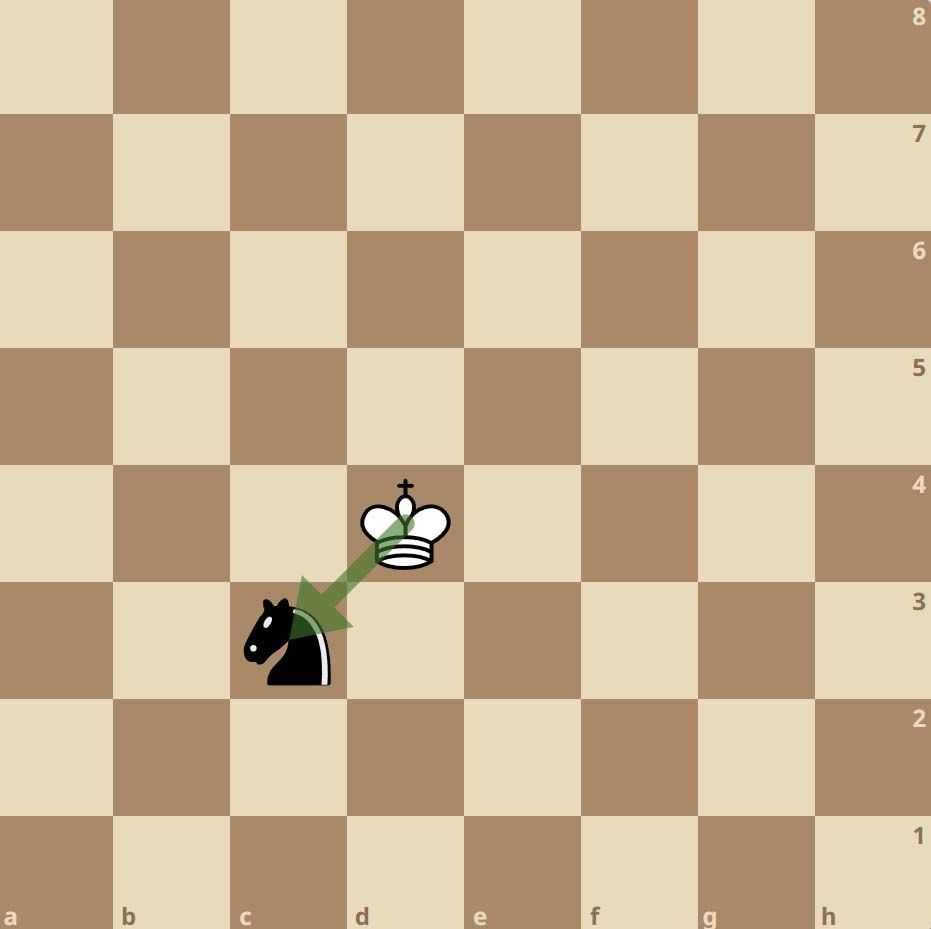
The king captures in the same way it moves: one square in any direction. When it moves to a square occupied by an enemy piece, the enemy piece is removed from the board, and the king occupies that square. However, capturing must be done with caution, as the king can never move to a square where it would be under attack.
Example of capture
Let’s imagine that the white king is on the d4 square and a black piece is on c3. The king can move to c3 and capture the black piece, occupying that square in the process.
Capture limitations
- Cannot capture if in check: The king cannot capture a piece if the square it moves to is controlled by an enemy piece.
- Cannot capture allied pieces: Like any other piece, the king cannot capture its own pieces.
Castling: special move of the king
Castling is a unique move in chess involving the king and one of the rooks. It is the only time when the king can move more than one square, and its purpose is to provide greater safety for the king and activate the rook. To castle, certain conditions must be met:
Conditions for castling
- Neither the king nor the rook must have moved previously: If the king or rook has already moved, castling is not allowed.
- There must be no pieces between the king and the rook: Castling requires that the squares between the king and the rook be empty.
- The king must not be in check or pass through an attacked square: During castling, the king may not pass through or end up on a square that is under attack.

Castling types
There are two types of castling, depending on which rook is involved:
- Short castling: The king moves two squares toward the kingside rook (right side for White), and the rook is placed next to the king, on the square to its left.
- Long castling: The king moves two squares toward the queenside rook (left side for White), and the rook is placed to the right of the king, on the adjacent square.
How much is the king worth in chess?
The king is the most important piece in chess, although technically it is not assigned a point value, since its capture represents the end of the game. Although its movement is limited to one square in any direction, the king plays a crucial role in the endgame, where it often becomes an active piece supporting and protecting pawns.
The king in chess strategy
The king has a specific role in each phase of the game. Its role evolves from defense in the opening and middlegame to a more active role in the endgame. Below, we explain how to use the king effectively in each phase of the game.
The king in the opening and middlegame
In the early stages of the game, the main objective is to protect the king. Moving it to the center of the board in these phases would be risky, as other pieces are active and can attack quickly. Therefore, castling is a fundamental tactic to place the king in a safer position.

The king at the end of the game
In the endgame, when many pieces have been removed from the board, the king becomes an active piece. Thanks to its ability to move in all directions, the king can help push pawns toward promotion or support the capture of enemy pieces. In this phase, the king can advance to the center of the board and take on an offensive role.

Importance of avoiding checkmate
Checkmate is the situation in which the king is under attack and has no legal move to escape. Avoiding checkmate is crucial, as it determines the opponent’s victory. Some ways to avoid checkmate include:
- Move the king: Moving the king to a safe square may be an option if one is available.
- Block the attack: Place a piece between the king and the piece threatening checkmate.
- Capture the attacking piece: In some cases, you can capture the piece that is threatening the king, eliminating the danger.
Example of checkmate
Let’s imagine that the black king is on the h8 square, the white queen is on g7, and a white rook is on f7. In this position, the black king has no escape and is in checkmate, as it cannot move to any free square or capture the attacking pieces.

Conclusion
The king is the most crucial piece in chess, and although its movement is limited, mastering its use is essential to protect it and avoid checkmate. From castling in the opening to its activation in the endgame, the king plays a fundamental role in every phase of the game.
We hope this article has helped you to better understand how the king moves, captures, and protects itself. If you want to learn to play chess or improve, it doesn’t matter your age or level, we have groups adapted for everyone. Find out more about our online chess classes here!


