

The pawn is one of the simplest yet most intriguing pieces in chess. Each player starts with eight pawns. Despite its apparent simplicity, the pawn has unique characteristics of movement and capture, and it is the only piece that can be transformed into another. In this article, you will learn in detail how the pawn moves and captures, as well as its strategic importance.
General characteristics of the pawn
The pawn is an apparently simple but key piece in chess. Here are some of its main characteristics:
- Value: It is assigned a value of 1 point, making it the lowest-valued piece in the game.
- Starting position: The white pawns start on the second rank (from a2 to h2) and the black pawns on the seventh rank (from a7 to h7).
- Promotion: When it reaches the eighth rank, the pawn can be transformed into any other piece, except the king. This rule is known as promotion and can drastically change the course of the game.

How does the pawn move?
The pawn has a particular way of moving: it always moves forward along the column it occupies. However, there are some variations in its movement depending on its position on the board.
Initial movement of the pawn
On its first move, the pawn has the option to move either one or two squares forward. This double move can only be made from its initial position. Once moved, the pawn can no longer move back or move two squares again in a single move.
Example: A white pawn on e2 can move to e3 or e4 on its first move. If it chooses to advance to e3, in subsequent turns it can only advance one square at a time.

Regular pawn movement
After its initial move, the pawn can only move one square forward per turn. This movement is restricted and depends on the presence of other pieces.
- Straight move: The pawn moves one square straight forward, provided that square is unoccupied.
- Cannot move backward: The pawn only moves forward; once moved, it cannot return to its original position or move backward on the board.

How does the pawn capture?
Unlike its forward movement, the pawn captures diagonally. This ability to capture to the sides gives it a unique role in both defense and attack. Below, we explain in detail how the pawn captures.
Diagonal pawn capture
To capture a piece, the pawn must move one square diagonally forward, either to the left or to the right. It cannot capture in a straight line, unlike its regular movement.
Example: If a white pawn is on e4, it can capture an enemy piece on d5 or f5, moving diagonally one square forward.

How much is the pawn worth in chess?
The pawn is the lowest-valued piece, worth 1 point, but its importance is crucial in the structure of the game. When it reaches the opposite end of the board, the pawn can become another piece (usually a queen), which adds a strategic layer to its use. Pawns also shape the structure of the game, influencing the development and maneuvering of all other pieces.
En passant capture
En passant is a special pawn capture that occurs in specific situations. This move allows a pawn to capture an enemy pawn that has just advanced two squares from its starting position and is adjacent to it.
Conditions for en passant
- Recent two-square move: The enemy pawn must have advanced two squares in a single move from its starting position.
- Immediately after the advance: The en passant capture must be made immediately after the enemy pawn’s move. If the player chooses not to capture on that turn, the opportunity disappears.
Example: If a white pawn is on e5 and a black pawn advances from d7 to d5, the white pawn can capture the black pawn en passant, moving from e5 to d6. The black pawn is removed from the board as if it had moved only one square.

Pawn promotion
One of the most interesting aspects of the pawn is its ability to promote. When a pawn reaches the eighth rank (for White) or the first rank (for Black), the player may transform it into another piece, typically a queen due to its power.
Promotion options
Upon reaching the final rank, the pawn can become:
- Queen: This is the most common choice, as the queen is the most powerful piece.
- Rook: In some strategic cases, it may be useful to gain an extra rook.
- Bishop: Sometimes it is preferable to obtain a bishop to maintain control over specific diagonals.
- Knight: In certain positions where the knight’s movement is advantageous, this is an interesting option.

Importance of promotion in the strategy
Promoting a pawn can completely change the course of a game. In the endgame, many players focus on advancing their pawns to the final rank to obtain a queen or any other piece needed to deliver checkmate or defend.
The pawn in chess strategy
Pawns play a fundamental role in chess structure and strategy. From protecting key pieces to advancing to threaten enemy territory, pawns are essential in building strong positional play.
The pawn structure
The arrangement of pawns on the board is known as pawn structure. This structure influences piece development and board control. Some key concepts include:
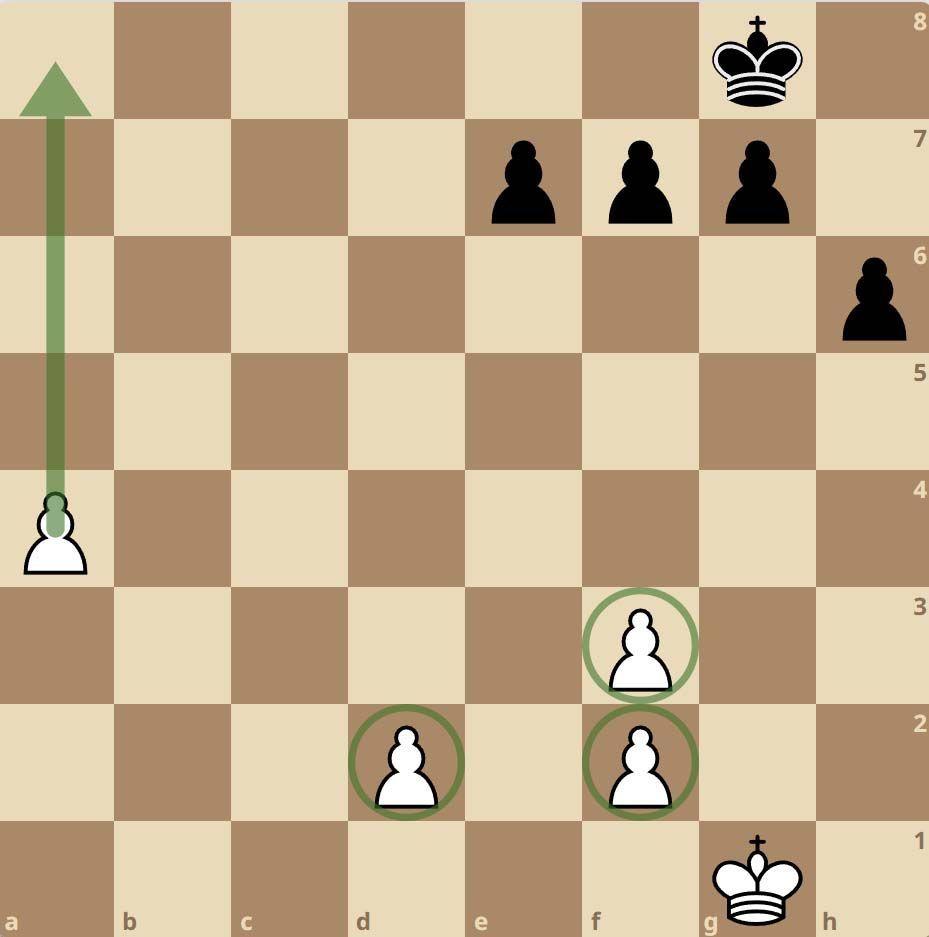
- Doubled pawns: When two pawns of the same color are on the same file, they are considered doubled. This can be a weakness, as it restricts their mobility.
- Isolated pawns: An isolated pawn has no pawns on the adjacent files, making it vulnerable to enemy attacks.
- Passed pawns: A passed pawn has no enemy pawns on its file or the adjacent files, making it easier to advance toward promotion. columns, which facilitates its advance towards promotion.
Find out more here about isolated pawns, doubled pawns and passed pawns.
The chain of pawns
A pawn chain is a formation where pawns protect each other diagonally. This structure provides a solid defense and helps control the center of the board.

Advancement and control of the center
Advancing pawns in the center of the board (files d and e) is a common opening strategy. Controlling the center in chess allows for greater piece mobility, and advancing pawns helps gain space and restrict the opponent’s movement.
Find out more about how to control the center in chess here.

Conclusion
The pawn is a fundamental and complex piece in chess, with unique movements and the ability to capture diagonally. Understanding its basic movement, en passant capture, and promotion is essential for improving your game. Although it is the least valuable piece, pawns are key to the structure and strategy of any chess game.
We hope this article has given you a deeper understanding of the pawn and its strategic possibilities in chess. If you want to improve your chess skills, no matter your age or level, we have groups adapted for everyone. So don’t hesitate to contact us for more information! 😉


