1. Introduction: Ernst Grünfeld and Modern Dynamic Chess
Ernst Grünfeld represents a silent yet decisive turning point in the history of chess. He was not a rhetorical revolutionary nor a systematic theorist like Nimzowitsch. His break with classical chess was more dangerous: it happened on the board, game by game, showing that inherited rules could be surpassed by the concrete activity of the pieces.
Grünfeld understood that the center was not an end in itself, but a temporary battlefield. He allowed the opponent to occupy it and then attacked it with surgical precision. This idea—now fully integrated into modern chess—was deeply disruptive in his time.
From a historical perspective, Grünfeld embodies the definitive shift from chess based on general principles to chess based on dynamic evaluation and exact calculation.
2. European Chess After the First World War
The historical context in which Grünfeld emerged is essential to understanding his thinking. Europe had just come out of the First World War, and the intellectual world was living through a deep crisis of closed systems and absolute truths.
Something similar happened in chess. Classical principles, inherited from Steinitz and refined by Tarrasch, began to show cracks. Players searched for new solutions, new ways to justify decisions that no longer fit rigid rules.
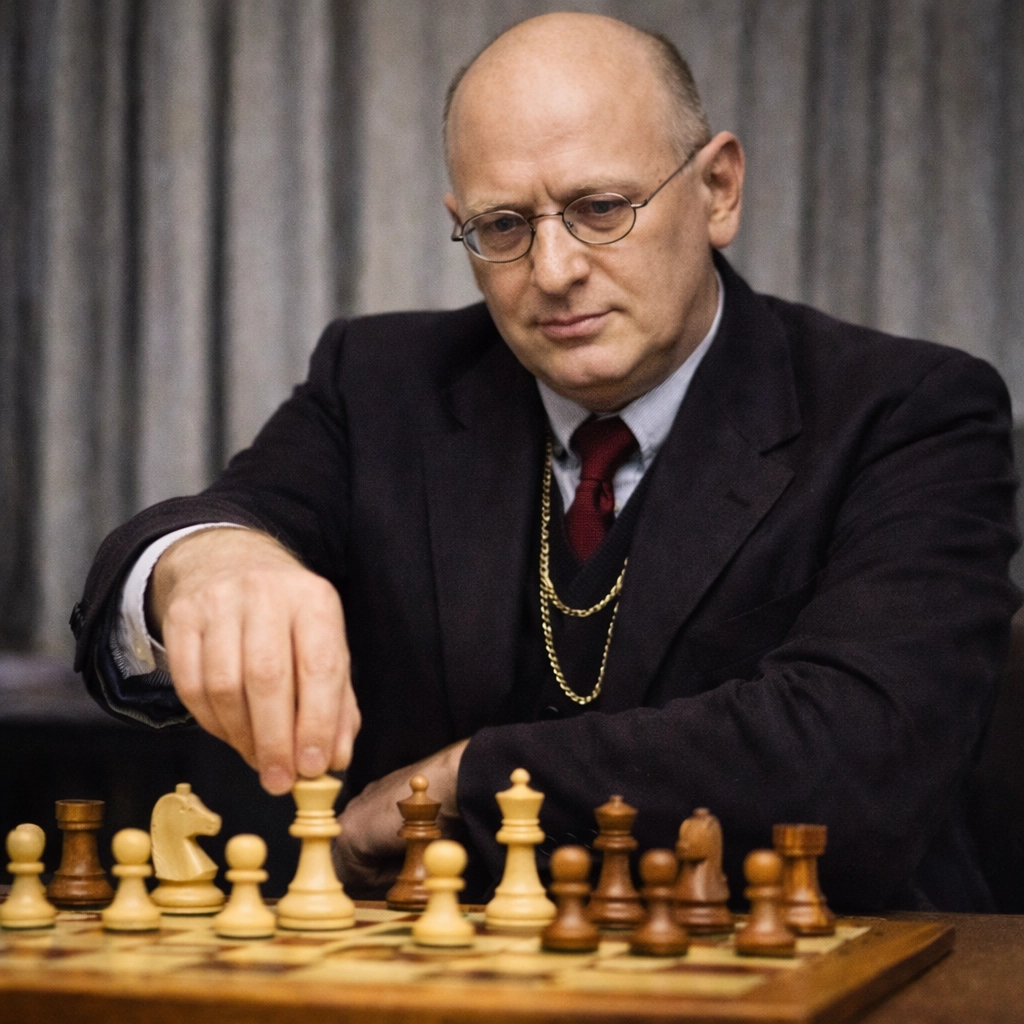
Grünfeld was formed in this climate of constructive skepticism, where the authority of dogma weakened and practical experience gained weight.
3. Origins, Development, and the Viennese Intellectual Environment
Ernst Grünfeld was born and developed within the cultural environment of Vienna, one of Europe’s intellectual capitals at the beginning of the 20th century. Music, philosophy, psychoanalysis, and science coexisted in an atmosphere where questioning what was established was almost the norm.
This context directly influenced the way he thought about chess. Grünfeld did not seek closed systems or totalizing explanations. He preferred concrete solutions to concrete problems.
Historically, this environment explains his distance from both classical dogmatism and the most theoretical hypermodernism. Grünfeld is, above all, an enlightened pragmatist.
4. Grünfeld as a Player: Pragmatism and Concreteness
As a player, Ernst Grünfeld stood out for a sober, precise, and extremely concrete style. He did not seek spectacular attacks or brilliant maneuvers without foundation. His strength lay in the correct evaluation of the position and in exploiting the activity of his pieces.
Grünfeld felt comfortable in tense, unbalanced, and dynamic positions. He did not fear conceding space or accepting seemingly inferior structures if, in return, he obtained initiative and real counterplay.
From a historical perspective, this profile makes him a precursor of modern professional chess, where objectivity prevails over aesthetics.
5. Questioning the Classical Center
One of Grünfeld’s greatest contributions is his way of questioning the classical occupation of the center. Unlike other reformers, he did not do it through a general theory, but through systematic practice.
Allowing the opponent to build a broad center and then attacking it with active pieces is an idea that demands absolute confidence in calculation. Grünfeld trusted that dynamics and pressure would compensate for any static deficit.
Historically, this vision anticipates contemporary chess, where the center is seen as a vulnerable structure, not an automatic fortress.
6. Piece Activity and Calculation Over Principles
In Grünfeld’s chess, piece activity is the supreme value. It is not enough to be well placed according to general principles; you must threaten, pressure, and force decisions.
This approach requires a high level of calculation and tactical precision. Grünfeld did not rely on fixed rules, but on concrete evaluation of variations. This way of thinking—common today among the elite—was revolutionary in his time.
From a historical perspective, this emphasis on concreteness marks a definitive break with 19th-century chess.
7. Grünfeld and the Hypermodern School
Although Grünfeld is often associated with hypermodernism, his relationship with that school is complex. He shares with figures like Nimzowitsch the critique of the classical center, but rejects excessive abstraction.
Grünfeld did not theorize about controlling the center; he attacked it. He did not write manifestos; he played sharp lines. His approach was less ideological and more operational.
Historically, this places him as a figure parallel to hypermodernism, but not subsumed by it. Grünfeld represents the most concrete and tactical wing of that transformation.
8. Grünfeld as an Architect of Concrete Chess
Beyond the famous defense that bears his name, Ernst Grünfeld should be understood as one of the architects of concrete chess, the approach that prioritizes dynamic evaluation over inherited rules.
His legacy is not a closed system, but an attitude: trust activity, accept calculated risks, and evaluate each position for what it is—not for what it “should be.”
Historically, this attitude became the norm in elite chess of the 20th and 21st centuries. In that sense, Grünfeld is not a figure of the past, but a permanent contemporary.
9. The Grünfeld Defense and Its Inner Logic
The Grünfeld Defense is not just an opening; it is a philosophical statement. Grünfeld deliberately accepts that White will occupy the center with pawns—something that for decades had been considered almost an unforgivable concession. But that acceptance is not passive; it is strategic.
The core of the defense lies in attacking the center from a distance, undermining it with active pieces and constant pressure. White’s center thus becomes a moving target, not a stable advantage. This conception requires precise calculation, perfect coordination, and absolute confidence in dynamics.
Historically, the Grünfeld Defense symbolizes the moment when chess stops rewarding static possession and begins to value activity and initiative as superior assets.
10. Grünfeld Against Alexander Alekhine, José Raúl Capablanca, and the Elite
Ernst Grünfeld’s clashes with the elite of his time are essential to understanding his historical stature. Against players like Alekhine or Capablanca, his chess does not shrink or become timid. He maintains his dynamic approach even against the very best.
Against Capablanca, famous for positional clarity, Grünfeld sets up tense and complex structures. Against Alekhine, a master of attack, he responds with defensive precision and active counterplay. In both cases, he proves that his vision is not only theoretical, but competitively viable.
From a historical perspective, these duels confirm that dynamic chess is not a marginal curiosity, but a real alternative to the dominant classicism.
11. Competitive Results and Practical Style
Although Grünfeld did not reach the world title nor dominate tournaments systematically, his results were consistent and respected. For years he remained within the circle of strong players, capable of competing with anyone on his best day.
His practical style is characterized by the absence of unnecessary drama. Grünfeld does not seek to shine; he seeks to solve the position. This competitive sobriety reinforces the solidity of his legacy: his ideas do not depend on isolated flashes of genius, but on applicable dynamic principles.
Historically, this type of career is often less celebrated, but it is crucial for consolidating new ways of playing.
12. Influence on Later Generations
The influence of Ernst Grünfeld becomes especially visible in later generations of dynamic players. His defense became a strategic laboratory used by world champions and grandmasters of different eras.
Beyond the specific opening, his approach—accepting structural risks in exchange for activity—filtered into modern chess as a general attitude. The idea that the center can be attacked, not only defended, became part of the common language.
Historically, this cross-cutting influence is the definitive proof of his structural relevance.
13. The Grünfeld Defense in the Engine Era
With the arrival of chess engines, many classical openings were revisited, and some were called into question. The Grünfeld Defense, however, not only survived—it came out strengthened.
Computer analysis confirmed that the dynamic activity Grünfeld intuited had solid objective foundations. Complex lines once considered risky were revealed to be perfectly playable.
From a historical perspective, this technological validation makes Grünfeld one of the great practical visionaries of modern chess.
14. Insights, Limits, and Historical Misunderstandings
Like any historical figure, Ernst Grünfeld also had limits. His extremely concrete approach could be demanding and was not always easy to apply for less precise players. In addition, his lack of an extensive theoretical body of work helped other thinkers attract more attention.
However, many misunderstandings about Grünfeld come from reducing him to “the man of one opening.” This simplification ignores his deeper impact: proving in practice that dynamism could defeat dogma.
Historically, this reduction is unfair and impoverishing.
15. Ernst Grünfeld’s Place in Chess History
Placing Ernst Grünfeld in chess history means recognizing him as a hinge figure. He is not the systematic theorist of hypermodernism, nor the iconic champion of classicism. He is the practical engineer who proves, on the board, that chess can be played differently.
His place is alongside those who made contemporary dynamic chess possible: a chess in which activity, calculation, and initiative weigh as much as—or more than—inherited rules.
As time passes, his figure gains relevance because chess has followed the path he helped trace.
16. Conclusion: When Dynamics Defeat Dogma
Ernst Grünfeld did not write manifestos or seek to overthrow systems with words. He did it with games. He showed that the center can be challenged, that development can be flexible, and that piece activity can compensate for structural deficits.
In chess history, Grünfeld holds a firm place as one of the great builders of modern chess, someone who helped free the game from rigid rules and brought it closer to its current form.
His legacy lives on every time a player allows the opponent to occupy the center… only to prove afterward that dynamics rule.