
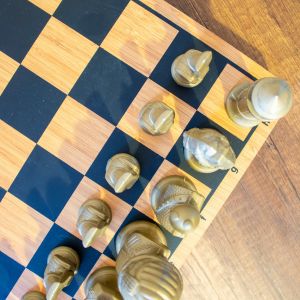
Pieces falling over during a game is one of the most common annoyances in chess, and also one of the most underestimated. At first it may seem like a minor detail, but when it happens repeatedly it ends up affecting the flow of the game, concentration, and in long games, even the player’s mood.
The most common assumption is that the problem is simply that the pieces “weigh too little.” In reality, tipping is usually the result of several combined factors: weight, balance, base, felt, and even the type of board or surface being used.
In this article, we analyze why pieces fall over and, more importantly, what real solutions exist to prevent it without needing to replace the entire set.
Weight: important, but not enough on its own
Weight is the first factor people usually point to, and rightly so. A piece that is too light is more likely to tip over with the slightest touch, especially in crowded positions or fast time controls.
However, adding weight without proper consideration does not always solve the problem. A heavy but poorly balanced piece may still fall over, because its center of gravity remains too high.
The goal is not for the piece to be heavy, but for it to be stable. And that depends as much on how the weight is distributed as on the weight itself.
Balance and center of gravity
Balance is, in many cases, more decisive than total weight. A well-balanced piece has a low center of gravity, which naturally helps it stay upright.
When weight is concentrated in the upper part (something common in decorative or poorly designed pieces), the piece behaves like a pendulum: any small bump can cause it to fall.
Properly weighted pieces, with the mass correctly placed in the base, offer much greater stability even with moderate overall weight.

The base of the piece: width and design
The base is another key element that is often overlooked. A narrow base reduces the contact surface with the board and increases the risk of tipping, especially for tall pieces like the king or queen.
Pieces designed for play usually have wide and well-proportioned bases, not for aesthetics but for functionality. This extra width improves stability and helps the piece “grip” the board better.
Decorative pieces, on the other hand, often sacrifice base size for visual elegance, making them much less stable for real play.
Felt: a small detail with a big impact
The felt on the base of the pieces serves two essential functions: protecting the board and improving stability. Good felt creates friction with the board’s surface, preventing sliding and small rebounds.
When the felt is very thin, poorly attached, or missing entirely, the piece rests directly on the wood or plastic of the board. This increases the risk of sliding or tipping, especially if the surface is smooth.
High-quality felt, properly fitted and in good condition, can make a huge difference in the feeling of stability.
The board and playing surface
Not all surfaces are the same. A very smooth board, overly varnished, or placed on an unstable table can contribute to pieces moving or falling more easily.
Additionally, if the board is too small for the size of the pieces, they become “crowded” within each square and frequently bump into each other, increasing the risk of tipping.
The correct combination of piece size, board, and surface is essential for a stable setup.
The human factor: how you play also matters
Although the equipment matters a lot, the way you play also plays a role. Rough movements, hitting the clock too hard, or constantly playing under time pressure increase the chances of knocking pieces over.
A stable set helps minimize these issues, but it is also useful to develop more controlled playing habits, especially in educational or training environments.
Practical solutions without changing your set
If your pieces fall over frequently, you do not always need to buy a new set. Some simple solutions include:
- improving or replacing the felt
- using a more stable surface
- matching the board size to the pieces
- avoiding unstable tables
These small adjustments can greatly improve the experience without a significant investment.
When the problem is the set itself
If, despite everything, the pieces keep falling over, it is likely that the set’s design is not suitable for play. This often happens with highly decorative, very tall, or poorly balanced pieces.
In that case, the real solution is to choose pieces designed for play, with clear Staunton proportions, good balance, and stable bases.
Conclusion
Pieces falling over is not an inevitable problem or something “normal.” In most cases, it has a solution by understanding the factors involved and how they interact.
A good balance between weight, balance, base, felt, and board completely transforms the playing experience. When everything fits together, the pieces stay where they should, and the player can focus on the only thing that matters: chess.


