1. Introduction: Irving Chernev and chess explained
Chess history is often written from the summits: world champions, great tournaments, theoretical revolutions. However, there is another history, just as decisive, that unfolds quietly: the history of how chess is taught, transmitted, and understood. Irving Chernev is one of the invisible pillars of that history.
Chernev understood something fundamental early on: chess does not fail for lack of depth, but for lack of explanation. For decades, chess knowledge was locked inside small circles, expressed in cryptic and inaccessible language. Chernev decides to break that barrier.
From a historical perspective, his importance lies not in innovating elite chess, but in democratizing its understanding—something that transforms the game as much as a new opening or a strategic school.
2. Chess before Chernev: reserved knowledge
Before Irving Chernev, much of chess literature was aimed at already-trained players. Texts assumed prior knowledge, used dense notation, and offered long analyses without a clear guide for the average reader.
This model reinforced an implicit hierarchy: chess as knowledge reserved for initiates. Learning to play well was a slow, often frustrating process, and depended heavily on access to strong clubs or experienced mentors.
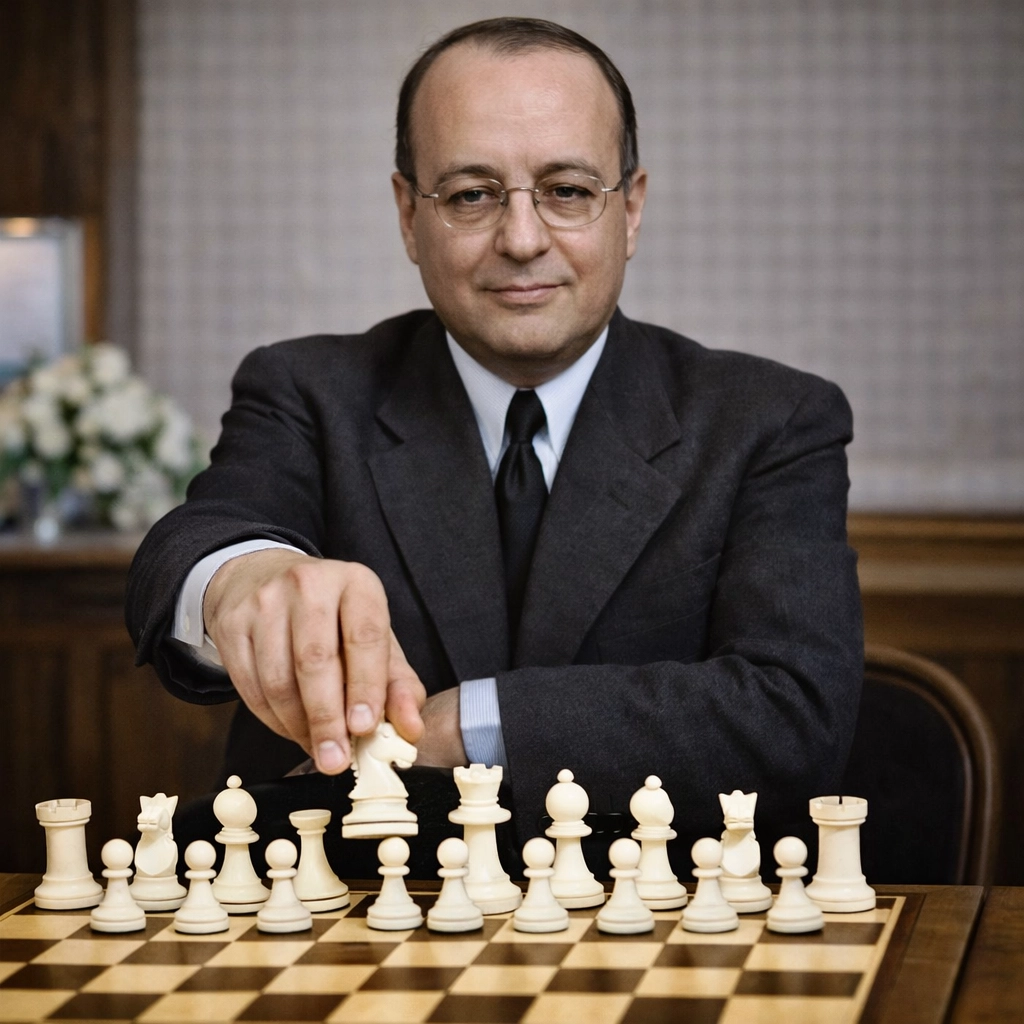
Chernev appears in this context as a pedagogical anomaly. Not because he simplifies chess until it is emptied, but because he chooses to explain every decision, every idea, every transition. Historically, this gesture has a deep and lasting impact.
3. Childhood, formation, and early ties to chess
Irving Chernev approaches chess from a position that is neither that of a prodigy nor that of an obsessive competitor. His relationship with the game starts early, but it is always marked by a broader intellectual curiosity.
He does not grow within a dominant school nor under the tutelage of legendary grandmasters. He learns, competes, studies, and above all observes how others learn. This sensitivity to the learning process will be key to his later evolution.
From a historical perspective, this origin explains why Chernev writes not to impress, but to accompany. His gaze is always on the reader.
4. Chernev as a player: limits and competitive context
As a competitive player, Irving Chernev reaches a respectable, but not extraordinary, level. He is not a World Championship contender nor a dominant figure of his era. And this fact, far from diminishing his value, defines his historical place with precision.
Chernev knows chess from the inside, but he also knows his personal limits. This self-awareness allows him to adopt another role, equally necessary: that of an interpreter between the elite and the base.
Historically, many of chess’s greatest popularizers were not champions. Their strength was not in results, but in translating complex ideas into usable knowledge.
5. The birth of the popularizer
Chernev’s shift from player to popularizer is neither abrupt nor forced. It is a natural transition. He begins to write, to comment on games, and to structure explanations that prioritize meaning over the accumulation of variations.
Chernev understands that the reader does not need to know everything, but to understand why things are done. This idea, seemingly simple, is revolutionary in its historical context.
From that moment, his work begins to build a different way of learning chess: less intimidating, more narrative, and deeply logical.
6. Irving Chernev’s literary style
Chernev’s style is one of his great historical contributions. He writes with clarity, rhythm, and an almost conversational voice. His texts do not overwhelm; they guide.
Every move is explained as part of a coherent story. Chess stops being a sequence of moves and becomes a strategic narrative you can understand. This narrative ability is exceptional and extremely rare.
Historically, this style shaped generations of players who learned to “think” chess before memorizing it.
7. Teaching chess without killing chess
One of Chernev’s greatest achievements is teaching without stripping chess of its beauty. Many instructional attempts fall into excessive simplification or cold didacticism. Chernev avoids both extremes.
He explains without infantilizing. He simplifies without betraying. He respects the reader’s intelligence while walking them step by step. This combination is extremely difficult to achieve and explains the longevity of his work.
From a historical perspective, this balance is one of the reasons his books are still read decades later.
8. Chernev as an architect of popular chess
Beyond specific titles, Irving Chernev builds something much broader: an accessible chess culture. His books do not directly produce world champions, but they form millions of players who understand the game.
This mass impact is hard to measure, but impossible to deny. Chernev helps create a wide, informed, passionate base without which modern chess would not have the same vitality.
Historically, his role is comparable to that of great science communicators: they do not discover new laws, but they make it possible for knowledge to circulate.
9. Logical Chess: Move by Move and the pedagogical revolution
If we had to point to a single book that represents Irving Chernev’s historical impact, Logical Chess: Move by Move would be the undisputed candidate. Published at a time when most chess texts assumed an expert reader, this book introduces an idea as simple as it is transformative: explain every move.
Chernev does not merely show good games; he walks through them step by step, explaining the purpose of each move, the alternatives rejected, and the inner logic of the position. In this way, the reader stops being a passive spectator and becomes an active learner of chess thinking.
From a historical perspective, this approach marks a turning point. Chess stops being a language reserved for those who already speak it and becomes a language that can be learned with patience and guidance. The influence of this book extends for decades and remains, even today, a privileged entry point for millions of players.
10. The Most Instructive Games of Chess Ever Played and the value of the annotated game
In The Most Instructive Games of Chess Ever Played, Chernev takes his instructional method to an even more ambitious level. It is not only about explaining moves, but about selecting games that function as complete lessons, where each phase of the game delivers a specific learning point.
Here, Chernev acts as an editor of chess knowledge. He chooses, orders, and annotates historical games with a clear criterion: that the reader finishes each one understanding something essential about chess. The book does not aim to impress with tactical rarities, but to build progressive understanding.
Historically, this kind of work helps fix a pedagogical canon. Many of the games considered “classics for learning” today are, in large part, classics because Chernev presented them as such to generations of readers.
11. Chernev and the relationship between art and instruction
One of Irving Chernev’s great merits is that he understood chess is simultaneously art and discipline. His books do not reduce the game to dry formulas, nor do they turn it into mere romantic poetry. They maintain a delicate balance between beauty and explanation.
Chernev writes about chess with aesthetic sensitivity. He describes plans, piece harmony, and strategic coherence without losing instructional clarity. The reader not only learns to play better; they learn to appreciate chess.
From a historical perspective, this synthesis is fundamental. Chess taught only as calculation loses its soul; chess presented only as art loses its usefulness. Chernev makes both aspects coexist.
12. Criticism, simplification, and misunderstandings
Like any influential figure, Irving Chernev has not been free of criticism. Some more technical authors have accused his work of oversimplifying, of omitting deep variations, or of presenting chess in an overly “clean” way.
These criticisms, while understandable from a specialized viewpoint, often ignore Chernev’s real goal. He does not write for grandmasters; he writes to form players who understand the game. His mission is not to exhaust analysis, but to open the path.
Historically, this misunderstanding is common with pedagogical figures. Clarity is often confused with superficiality. Time, however, has been favorable to Chernev: his books are still read when many more technical treatises have become obsolete.
13. Real influence on generations of players
Irving Chernev’s impact is not measured in titles or ratings, but in something far broader: the way millions of players think. From club amateurs to established masters, countless chess players acknowledge having learned to structure their thinking through his books.
Chernev taught how to ask the right questions at the board: What is the opponent threatening? Which piece is badly placed? What plan makes sense here? These seemingly basic questions are the core of well-played chess.
Historically, this massive influence makes Chernev a structural figure. He does not create champions directly, but he creates the fertile ground from which they can emerge.
14. Chernev compared to other great popularizers
Compared to other great chess popularizers, Irving Chernev holds a very particular place. Unlike more technical or more theoretical authors, his focus is always on the learning reader, not on the expert evaluator.
His style contrasts with that of denser, more academic popularizers. Chernev does not seek intellectual authority; he seeks real understanding. In that sense, his work is closer to a great teaching master than to a researcher.
From a historical perspective, this profile makes him an indispensable bridge between elite chess and everyday chess.
15. Irving Chernev’s place in chess history
Placing Irving Chernev in chess history means expanding the definition of greatness. He was not world champion, but he shaped the chess thinking of entire generations. He did not innovate an opening, but he taught people how to understand openings.
His place is alongside chess’s great cultural builders, those who make it possible for knowledge to be transmitted, renewed, and expanded. Without figures like Chernev, chess would be a much more closed and less alive game.
Historically, his importance does not diminish over time; it increases, because his work continues to fulfill its original function.
16. Conclusion: chess that is understood is chess that lives
Irving Chernev understood something essential: chess survives only if it is understood. It is not enough for there to be a brilliant elite; there must be a broad base that understands, enjoys, and practices the game.
His legacy is not spectacular or loud, but it is deep and lasting. Chernev taught people to think chess, not to memorize it. And that kind of teaching, when it is authentic, transcends generations.
In chess history, Irving Chernev occupies a quiet but indispensable place: that of the man who made chess an accessible language without betraying its depth. Without him, modern chess would simply be less understandable.