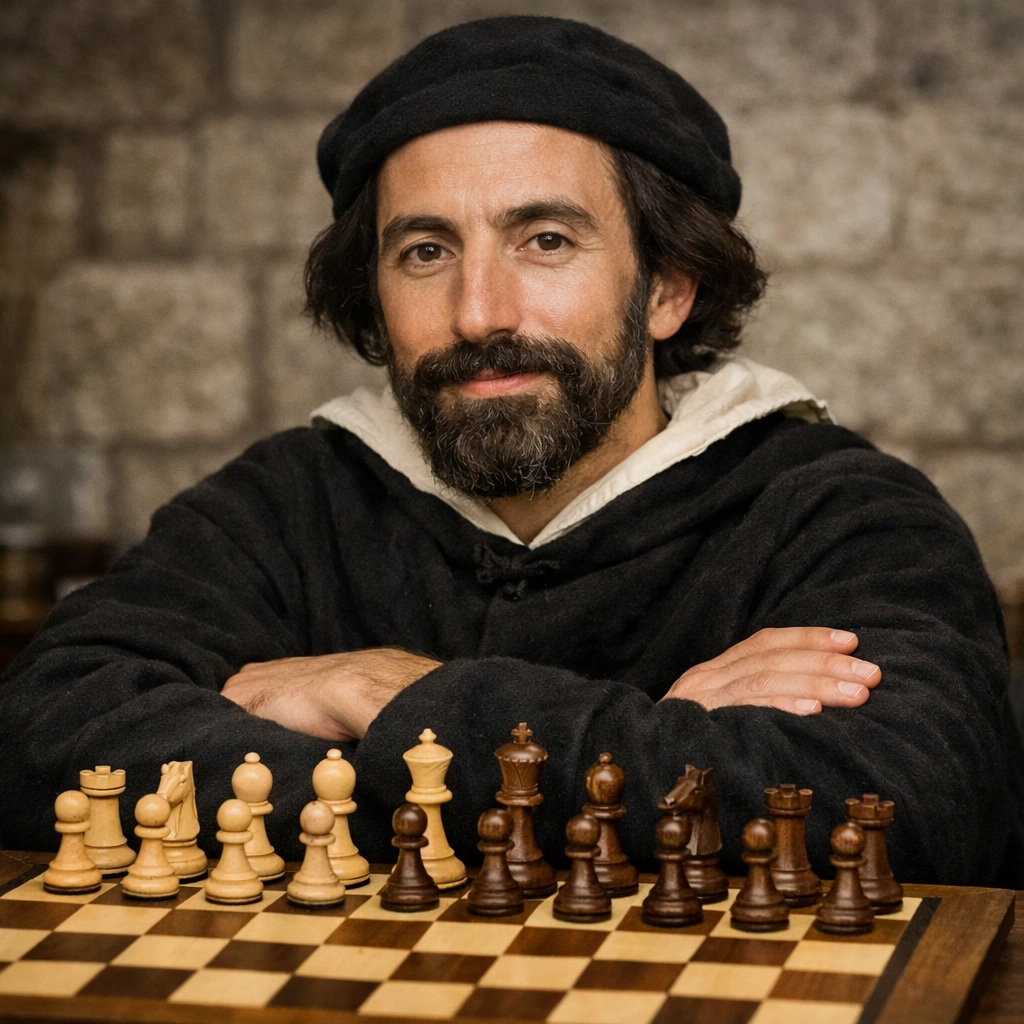
1. Introduction: Who Luis Ramírez de Lucena Was and Why He Is a Foundational Figure
Luis Ramírez de Lucena occupies an absolutely central place in the history of chess, although for centuries his name has been less well known than that of other later masters. His importance does not lie in a competitive career (chess did not work that way yet), but in something much deeper: he was the first great codifier of modern chess.
Lucena is fundamental because he:
- wrote the first printed book that describes chess with modern rules
- documented the transition from medieval to Renaissance chess
- introduced a systematic pedagogical vision
- laid the foundations for endgame study
Without Lucena, modern chess would not have a clear birth certificate. With him, the game acquires form, rules, and written memory.
2. Chess Before Lucena: Old Rules and Medieval Thinking
To understand Lucena’s significance, we have to look at the chess that preceded him. During the Middle Ages, chess was played with different rules:
- the queen had limited movement
- the bishop moved in a restricted way
- the pace of the game was slow
- strategy was based on gradual accumulation
This “old chess” was profoundly different from what we know today. There were no quick attacks or dynamic sacrifices; the game was more positional, but also much more rigid.
Lucena appears at the exact moment when the rules evolve, and his work becomes the first clear testimony of that change.
3. Spain in 1497: Historical, Cultural, and Publishing Context
Lucena’s book was published in 1497, in a Spain living through an exceptional historical moment. The country was:
- an emerging political power
- a cultural center of the Hispanic Renaissance
- one of the most advanced publishing hubs in Europe
The printing press made it possible, for the first time, to fix and spread knowledge on a massive scale. Lucena took advantage of this context to do something revolutionary: put chess into writing in a systematic way.
It is no coincidence that this step happened in Spain. Chess had been cultivated for centuries on the peninsula, and Lucena gathered that tradition in order to project it into the future.
4. Lucena’s Origins and Intellectual Formation
Although biographical data about Lucena are limited, his work reveals a solid intellectual formation. He does not write like a simple amateur, but like someone who:
- masters rhetoric
- understands the structure of knowledge
- knows how to explain clearly
Lucena does not merely show games; he organizes knowledge, classifies it, and presents it with a didactic intention. This clearly distinguishes him from earlier authors, whose texts were fragmentary or purely descriptive.
His mindset is already Renaissance, not medieval.
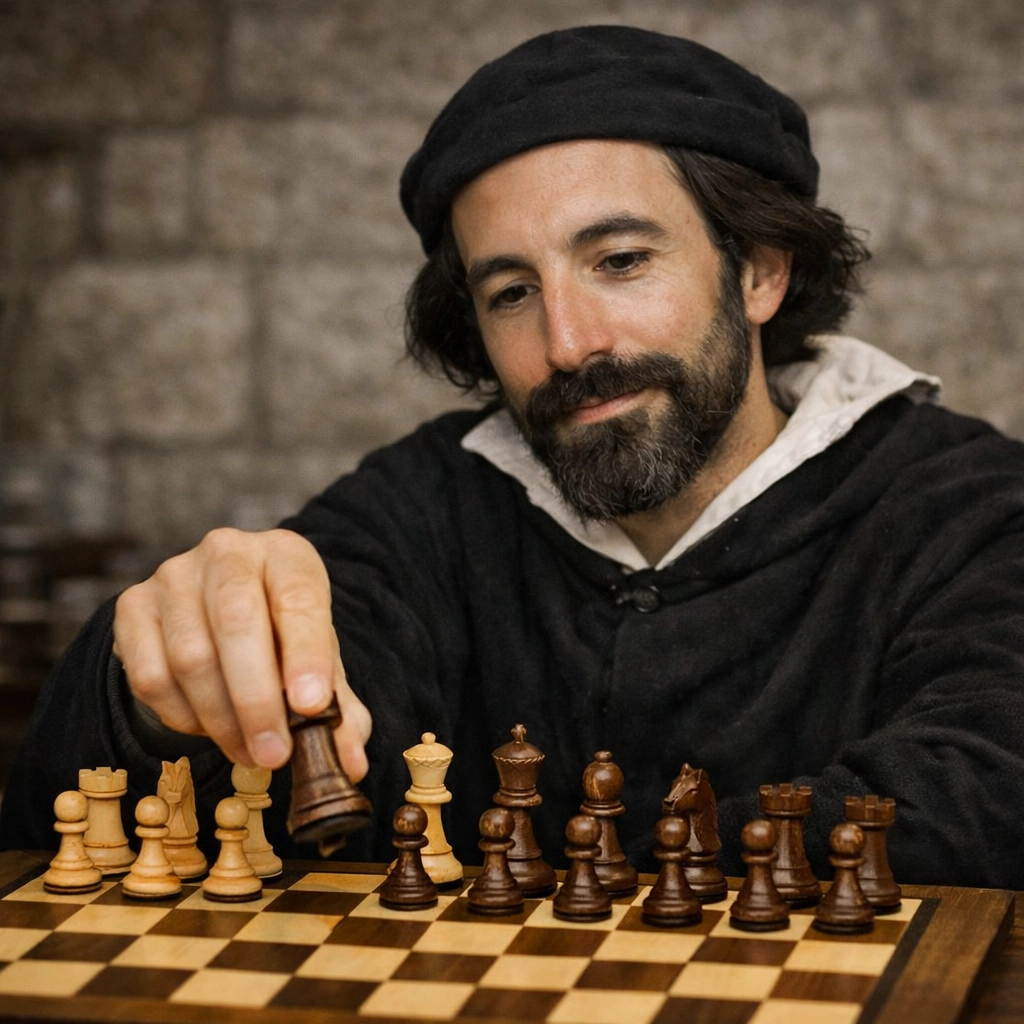
5. Repetición de Amores y Arte de Ajedrez: a Pioneering Work
The full title of Lucena’s work, Repetición de Amores y Arte de Ajedrez, may seem strange to the modern reader, but its content is revolutionary.
The book combines:
- chess problems
- rule explanations
- practical examples
- implicit reflections on the game
It is the first printed book that presents modern chess as an autonomous discipline. It is not a cultural appendix or minor entertainment: it is an art worthy of its own study.
Historically, this book marks the beginning of modern chess literature.
6. The New Rules: the Birth of Modern Chess
One of the most important aspects of Lucena’s work is that it describes chess with the new rules, especially the powerful movement of the queen.
This change transforms the game completely:
- the pace speeds up
- attack becomes central
- tactics take center stage
- chess becomes dynamic
Lucena did not invent these rules, but he was the first author to fix them in writing, allowing their uniform diffusion. In this sense, he is the notary of modern chess’s birth.
7. Lucena as a Teacher: Problems, Examples, and Method
Lucena understood that chess is learned by solving problems, not by memorizing rules. His book includes many examples designed to:
- train vision
- understand endgames
- practice coordination
This pedagogical approach is surprisingly modern. Lucena does not only show “what happens,” but leads the reader to think chess.
Here we find the seed of the systematic study that centuries later authors like Philidor would develop.
8. The Lucena Position and a Technique That Survived Five Centuries
The so-called Lucena position is one of the best-known setups in chess, and its name is no accident. It represents a fundamental rook endgame technique that is still taught today.
That an idea formulated at the end of the 15th century is still valid shows:
- the depth of Lucena’s analysis
- the universality of certain principles
- the solidity of his thinking
This position is not a historical curiosity, but a living tool, used by players of all levels.
9. Lucena Versus the Medieval Masters
To understand Lucena’s significance, it helps to compare him with the medieval authors who preceded him. In the Middle Ages, chess treatises often had a:
- symbolic
- moralizing
- fragmentary
Chess appeared as an allegory of social order, war, or virtue, more than as an autonomous technical discipline. Problems existed, but there was no clear will to systematize knowledge.
Lucena breaks with this tradition. His work is no longer a moral treatise, but a practical manual. Chess stops being a metaphor and becomes an object of study. This break marks the true step from medieval chess to modern chess.
10. Lucena’s Influence on Endgame Theory
If there is one area of chess where Lucena’s imprint is especially deep, it is endgames. His work shows an early understanding of something that would take centuries to be fully accepted: endgames are not merely leftovers of the game, but a phase with its own laws.
Lucena analyzes positions with:
- an active king
- rook-and-pawn coordination
- use of space
- precise technique
These ideas anticipate all modern endgame theory. The famous position that bears his name is not an isolated exception, but the most visible example of a structured and logical way of thinking.
From a historical point of view, Lucena is the first great endgame theoretician.
11. Lucena and the Transition to Renaissance Chess
Lucena does not only mark a change in rules and technique, but also in mindset. His work fully reflects the spirit of the Renaissance:
- interest in practical knowledge
- confidence in reason
- a desire to organize and classify
Renaissance chess is born when the game is conceived as something that can be studied, taught, and improved through method. Lucena embodies this transition better than any other author.
With him, chess leaves behind medieval mystery and enters the era of rational explanation.
12. Diffusion, Translations, and European Reception
Although Lucena’s book was published in Spain, its impact did not remain limited to the peninsula. His ideas spread quickly across Europe thanks to:
- copies
- translations
- later adaptations
Italian, French, and German authors drew on his work, sometimes without explicitly citing him. For decades, modern chess was built on the foundation Lucena had fixed.
This phenomenon is common in the history of knowledge: the pioneer is not always the most cited, but often the most influential.
13. Lucena Versus Greco and Philidor: Historical Continuity
Placing Lucena alongside Greco and Philidor helps us understand the complete evolution from old chess to modern chess.
- Lucena fixes the rules and the basic method
- Greco exploits the tactical potential of the new game
- Philidor introduces structure and strategy
Lucena is the starting point. Without him, Greco would not have the dynamic board he needs to create tactical beauty, and Philidor could not develop his strategic thought.
In this sense, Lucena is the common origin of two great traditions that may seem opposed: artistic chess and scientific chess.
14. Modern Criticism and Historiographical Debates
As with all foundational figures, Lucena’s work has been debated. Some historians have pointed to:
- possible technical errors
- imprecise positions
- limitations typical of his time
However, these criticisms lose force when the context is understood. Lucena did not aim for modern analytical perfection, but to give shape and coherence to a game in full transformation.
From a historiographical perspective, his value lies not in every individual move, but in being the first to bring order to chaos.
15. Lucena’s Place in Chess History
Placing Lucena in chess history is relatively easy when a broad view is adopted. He is not a great attacker, nor a refined strategist in the later sense, but something even more important:
he is the zero point of modern chess.
Everything that comes after—openings, tactics, endgames, theory—rests on the framework he helped build. His legacy is quiet, but absolute.
In historical terms, Lucena does not close an era: he inaugurates it.
16. Conclusion: Where Modern Chess Really Begins
If we had to point to a specific moment when chess stops being medieval and becomes modern, that moment would be linked to the work of Luis Ramírez de Lucena.
With him:
- chess gains stable rules
- knowledge is fixed in writing
- teaching becomes systematic
- endgames begin to be studied
Lucena did not seek fame or spectacle. He sought order, clarity, and transmission. Thanks to that, chess was able to evolve for centuries without losing its identity.
That is why, more than five hundred years later, his name still appears in manuals, endgames, and historical studies.
Not as an old curiosity, but as the true beginning of modern chess.