
1. Introduction: Phiona Mutesi and chess off the map
The official history of chess has been written, for centuries, from a few very specific geographic and cultural centers. Europe, Russia, the United States, and more recently East Asia have concentrated almost the entire narrative. Phiona Mutesi enters this story from a place that did not even appear on the chess map.
She is a historical figure not because she conquered the highest titles, but because she proves something deeply uncomfortable for the traditional narrative: chess is not anyone’s natural property. What has historically been missing in certain regions is not talent, but access, time, and legitimacy.
Phiona Mutesi does not enter chess through cultural vocation or family tradition. She enters because chess appears as an unexpected possibility within a context where almost none exist.
2. Chess and extreme poverty: a silenced history
Talking about Phiona Mutesi forces us to talk about extreme poverty—something chess often avoids. The game is often presented as universal, but its real practice has historically been tied to leisure time, formal education, and protected spaces.
Poverty does not only limit material resources; it limits the right to think long term. In daily-survival contexts, chess can seem like an impossible luxury. That Phiona Mutesi reaches international tournaments from that starting point is not a romantic miracle, but a historical anomaly that reveals deep structural failures.
From this perspective, her story should not be read as an inspiring exception, but as a silent indictment.
Katwe, one of Kampala’s poorest neighborhoods, is not a literary setting. It is an environment marked by precariousness, informal labor, and the absence of safety nets. Phiona Mutesi grows up there, in a context where formal education is not guaranteed and where the future is often reduced to the short term.
Chess appears in Katwe in an almost subversive way. Not as an elite sport, but as a community activity driven by social projects. In that environment, the board becomes a space of order within chaos, a logical structure in an unpredictable world.
Historically, this detail is key. Chess does not arrive as a cultural imposition, but as a tool adapted to a specific reality.
4. Discovering chess as an intellectual refuge
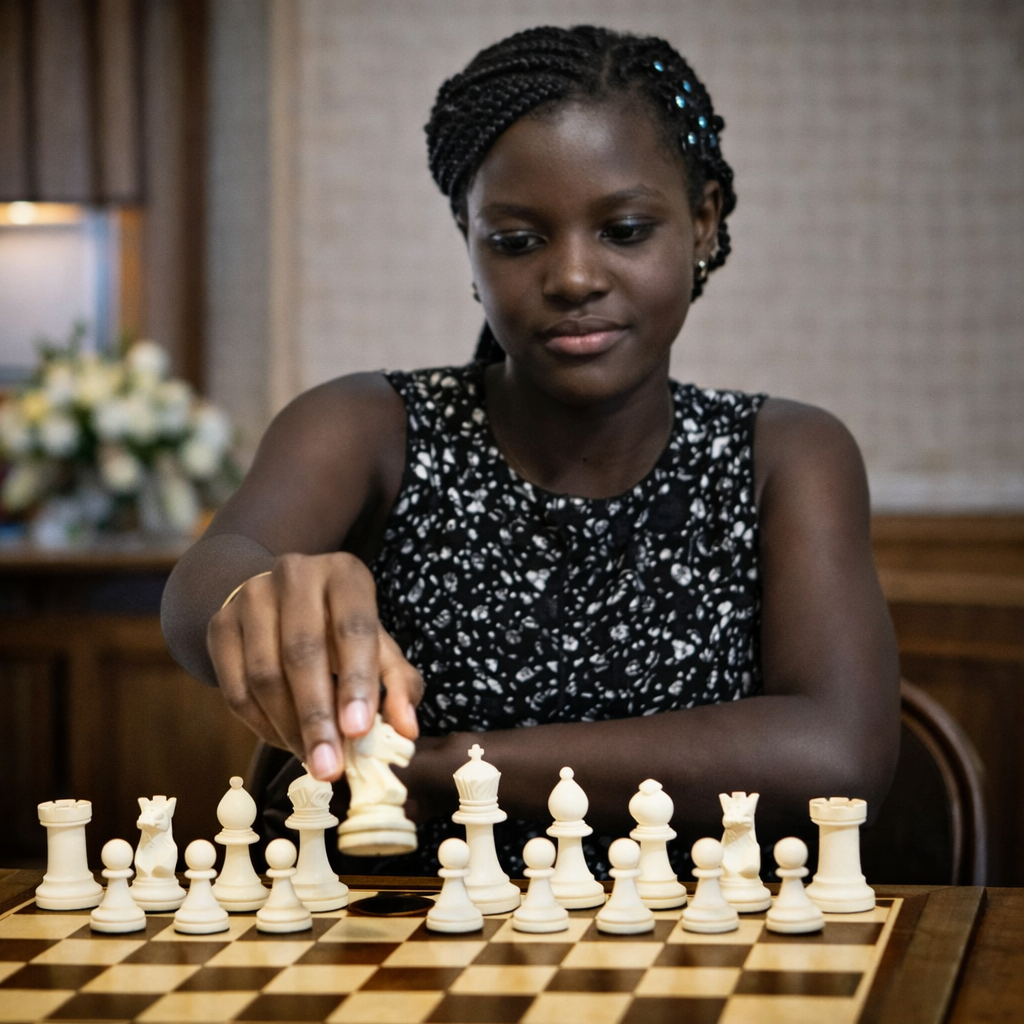
For Phiona Mutesi, chess is not initially competition or international ambition. It is refuge. It is a place where rules are clear, where intellectual effort has immediate reward, and where social origin temporarily disappears.
This discovery is deeply significant from a historical point of view. Chess, in its purest form, becomes a symbolic equalizer, even if the system around it is not.
Phiona learns chess not as a prodigy surrounded by resources, but as someone who discovers that thinking can be a form of resistance.
5. Self-taught training and learning under extreme conditions
Phiona Mutesi’s learning takes place under conditions that challenge any traditional training model. There are no specialized libraries, elite coaches, or technology. There is observation, repetition, memory, and an enormous will to understand.
This kind of learning produces imperfect chess, but deeply intuitive. Phiona develops a very direct relationship with the board, based on experience and solving concrete problems, not abstract theory.
Historically, this process recalls the popular origins of chess before its elitist institutionalization. Her way of learning connects with a forgotten tradition of the game.
6. Phiona Mutesi’s playing style
From a strictly chess perspective, Phiona Mutesi’s game is characterized by fighting spirit and an absence of stage fright. She is not a technical player in the classical sense, but she is extraordinarily resilient.
Her style reflects her context: constant struggle, adaptation, and the ability to endure difficult positions. She does not play for aesthetics or recognition, but to survive within the game.
Historically, this kind of chess is often underestimated by purely technical analysis, but it is inseparable from the player’s lived experience.
7. Competition, pressure, and media exposure
Phiona Mutesi’s entry into international competitions introduces an entirely new kind of pressure. She no longer competes only for herself, but as an involuntary symbol of external narratives: poverty, Africa, overcoming adversity, inspiration.
This symbolic burden is heavy and, in many cases, unfair. Competitive chess demands concentration and emotional stability—two things difficult to sustain when every game seems to represent something more than a sporting result.
From a historical perspective, this point is key to understanding the real limits of her chess career.
8. Phiona Mutesi as a symbolic rupture of elitist chess
Beyond her results, Phiona Mutesi represents a profound symbolic rupture. Her mere presence in official tournaments questions the implicit idea of who “belongs” in chess.
She does not break the system from within, but from outside. Her story forces recognition that chess has historically been a privilege disguised as universality.
In this sense, Phiona Mutesi is not only a player: she is an uncomfortable mirror for chess history.
9. Sporting results and analysis without romanticism
At this point, it is essential to address Phiona Mutesi’s sporting career with historical honesty, moving away from both elitist disdain and exaggerated romanticism. Her results, measured by strictly competitive criteria, do not place her among the great technical figures of world chess. And acknowledging that does not diminish her story; on the contrary, it dignifies it.
Phiona competed in official national and international events with uneven results. She achieved important wins, but she also suffered harsh losses, especially as the technical level and theoretical preparation of her opponents increased. This pattern is perfectly understandable given her formative context, radically different from that of most rivals.
Historically, demanding from Phiona Mutesi a trajectory typical of a player trained in European or Asian academies would be a form of symbolic violence. Her career must be evaluated from the real starting point, not from the abstract ideal of professional chess.
10. Olympiads, tournaments, and international representation
Phiona Mutesi’s participation in Olympiads and international competitions has value that goes beyond the scoreboard. Representing Uganda in these events means inscribing a historically absent country into the global chess narrative.
In these tournaments, Phiona faces not only better-prepared opponents, but entirely different structures. Each game is played under multiple pressure: sporting, symbolic, and media-driven. She is not only a player; she is a living representation of a story others have built.
From a historical perspective, this burden explains many of the competitive difficulties she experiences. And it also explains why her mere presence in these events already constitutes a historically relevant fact, regardless of the final score.
11. Queen of Katwe and the construction of the myth
The film adaptation of her story, Queen of Katwe, marks a decisive turning point. The movie turns Phiona Mutesi into a global symbol, but it also radically simplifies her experience to fit a universal narrative of overcoming adversity.
Cinema needs clear arcs, visible victories, and comforting endings. Reality, by contrast, is far more ambiguous. The film elevates Phiona’s figure, but it also traps her inside a myth that is hard to escape. From that moment on, her public identity is conditioned by a story that no longer fully belongs to her.
Historically, this phenomenon recurs whenever chess enters popular culture. The game becomes metaphor, and players become symbols. In Phiona’s case, the risk is evident: that the myth eclipses the real person.
12. Strengths and limits from an honest chess perspective
From a purely chess analysis, Phiona Mutesi shows clear virtues: fighting spirit, practical intuition, and a notable capacity for psychological resistance. In chaotic positions, her competitive instinct helps her find unexpected resources.
However, there are also evident limits, especially in deep theoretical preparation, endgame technique, and the handling of complex strategic positions. These limits are not individual failures, but structural consequences of her formative environment.
Historically, recognizing these limits is essential so her story is not turned into a caricature. Phiona does not need to be presented as a champion she never was for her figure to be historical.
13. Education, gender, and real opportunities
One of the most important—and least discussed—aspects of Phiona Mutesi’s story is the intersection of education, gender, and opportunity. Her late and partial access to formal education profoundly shapes her development, both in chess and in life.
Women’s chess, even in privileged contexts, already faces specific barriers. In contexts of extreme poverty, those barriers multiply. Phiona fights not only opponents on the board, but also social expectations, material limitations, and imposed roles.
From a historical perspective, her trajectory starkly exposes the structural inequalities that still shape real access to competitive chess.
14. Impact in Africa and in global chess
Phiona Mutesi’s impact in Africa is profound, though difficult to measure with traditional statistics. Her figure has served as a symbolic catalyst for social projects, educational programs, and greater visibility of chess as a formative tool.
However, her story also reveals the limits of individual inspiration. A symbol does not replace a structure. Without sustained investment, continuous training, and institutional support, the multiplier effect fades.
Historically, Phiona Mutesi represents both the potential of chess in Africa and the persistent shortcomings of the global system in sustaining that potential.
15. Phiona Mutesi’s place in chess history
Placing Phiona Mutesi in chess history requires abandoning traditional categories. She is not a world champion, not a technical innovator, and not a dominant figure. Her place is different—and not lesser for that.
Phiona is a limit figure: a player who forces chess history to look toward zones it had systematically ignored. Her relevance lies not in what she won, but in what she revealed.
In that sense, her historical place is comparable to that of other figures who did not transform the game from the top, but from the margins.
16. Conclusion: when chess stops being privilege
Phiona Mutesi does not prove that “anyone can reach the top” by playing chess. That reading, although popular, is false and dangerous. What she does prove is something far more uncomfortable and necessary: that chess has historically been a privilege, not a real universality.
Her story is not a fairy tale, but a crack in the official chess narrative—a crack through which questions about access, inequality, representation, and intellectual dignity seep in.
In chess history, Phiona Mutesi occupies a unique place. Not as a romantic heroine, but as a living testimony of what chess can be when it stops excluding.