1. Introduction: who Rudolf Spielmann was and why he is a singular figure
In the history of chess, oversimplifying labels abound. Rudolf Spielmann has for decades been called a “romantic attacker,” a “compulsive sacrificer,” or an “artist of the board.” However, those labels, although they contain some truth, do not do justice to the real complexity of his thinking.
Rudolf Spielmann was much more than a brilliant and spectacular player. He was a chess player deeply aware of the dynamic value of material, a thinker who understood sacrifice not as an emotional gamble, but as a legitimate strategic tool at a key moment of historical transition.
Spielmann occupies a unique place because he lived through (and embodied) the conflict between two eras:
- the romantic chess of the 19th century,
- and the scientific and positional chess of the 20th century.
Far from being trapped between the two, Spielmann built a language of his own. His chess was not nostalgia: it was calculated risk.
2. Chess between two worlds: from romanticism to modern thought
Spielmann developed his career in a particularly complex period in the history of chess. Classical romanticism — based on direct attacks, intuitive sacrifices, and tactical brilliance — was being challenged by new, more rational and structured currents.
On the one hand:
- Steinitz had introduced positional logic,
- Tarrasch had systematized classical principles,
- and Nimzowitsch was beginning to break dogmas with hypermodernism.
In that context, sacrifice seemed suspicious, a relic of the past. Spielmann, however, understood something fundamental: sacrifice does not disappear when science arrives; it evolves.
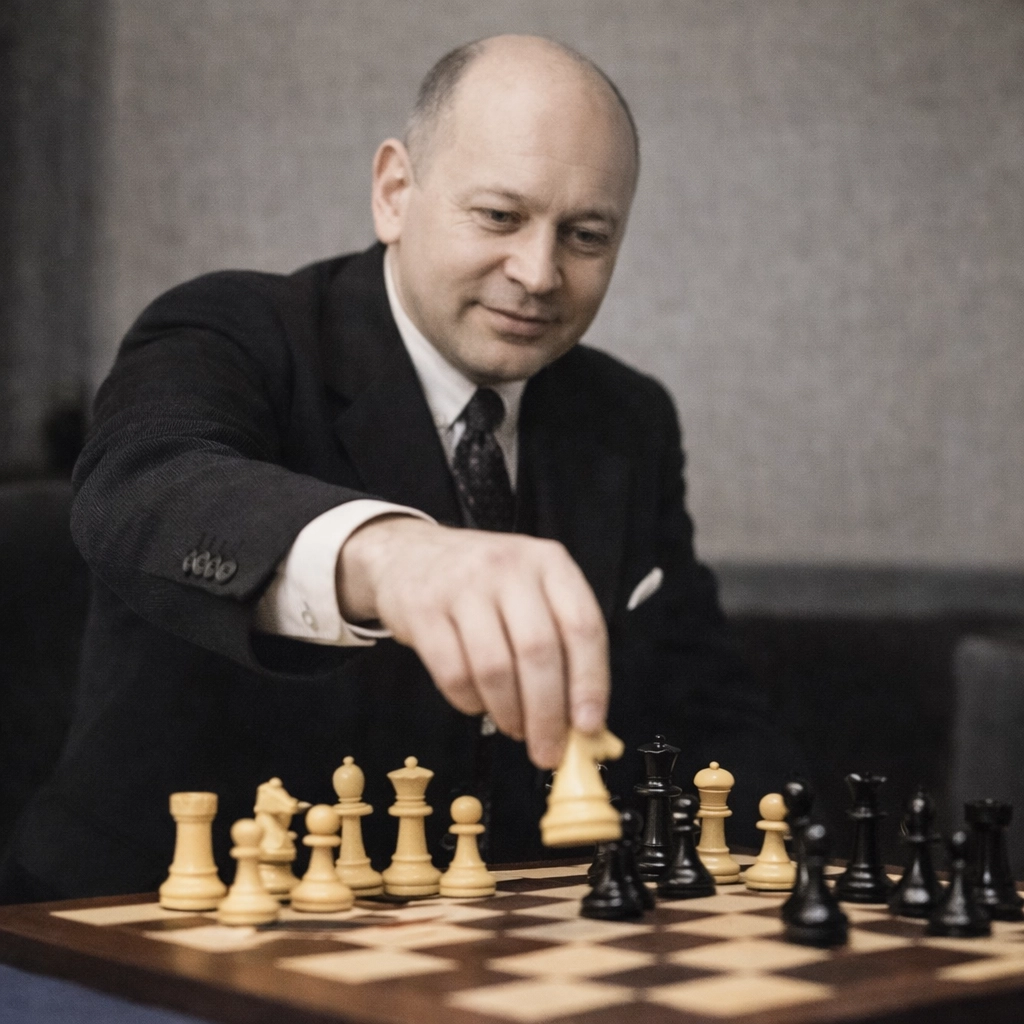
His chess shows that attack can coexist with logic, and that material is not an end in itself, but a means to create activity, initiative, and coordination.
3. Origins, training, and historical context
Rudolf Spielmann was born in the heart of a culturally rich but politically turbulent Central Europe. This environment deeply influenced his character and his vision of chess as an intense intellectual struggle, not as a cold academic exercise.
His training was largely self-taught. He studied the great attackers of the past, but also absorbed modern ideas. He did not merely imitate; he synthesized.
From a young age he showed:
- great tactical sensitivity,
- excellent intuition for the initiative,
- and a natural understanding of piece coordination.
Unlike other players of his time, Spielmann did not seek external theoretical validation. He trusted his practical judgment and his ability to evaluate dynamic positions better than most of his rivals.
4. Competitive rise and his place in the elite
Spielmann was not a marginal figure or an isolated artist. For several years he was a true elite player, capable of competing on equal terms with the best chess players in the world.
His rise was based on:
- solid results in major tournaments,
- spectacular victories against established grandmasters,
- and a growing reputation as an extremely dangerous opponent.
Although he was never world champion nor a direct challenger for the title, his presence in major tournaments was feared. Opponents knew that against Spielmann it was not enough to play “correctly”: one had to defend with absolute precision, because any concession could be fatal.
5. Spielmann as a player: style, intuition, and courage
Spielmann’s style is characterized by a quality rare even today: rational courage. He did not attack on impulse, but because he understood that the initiative, correctly managed, can compensate for material.
His chess is based on:
- rapid mobilization of pieces,
- control of open lines,
- constant pressure on the enemy king,
- and sacrifices aimed at clear objectives.
Spielmann did not fear being objectively “worse” in material terms if he obtained activity in return. This mentality makes him one of the precursors of modern dynamic chess.
6. Sacrifice as a strategic concept
Spielmann’s great intellectual contribution is his understanding of sacrifice as a strategic concept, not as a romantic act.
For him:
- material is only a form of energy,
- the initiative is a real resource,
- and piece activity can have a value superior to a pawn or even a piece.
Spielmann clearly distinguished between:
- correct sacrifices, based on objective factors,
- and incorrect sacrifices, born from aesthetic desire.
This distinction separates him from the pure romantics and places him as an advanced thinker in the history of attack.
7. Preferred openings and structures
In the openings, Spielmann sought positions that would allow him immediate active play. He preferred open or semi-open structures, with possibilities for early attack and clear imbalances.
He was not a dogmatic theoretician, but he understood very well:
- what types of positions favored his style,
- when he had to accelerate the game,
- and when to prepare the sacrifice with prior maneuvers.
His approach influenced the modern perception of openings as vehicles for the middlegame, not as closed theoretical ends in themselves.
Beyond his games, Spielmann left a theoretical contribution of enormous value through his writings. His work on sacrifice is one of the most important in the history of chess.
In it, he does not glorify blind attack, but educates judgment. He teaches when to sacrifice, why to do it, and above all, when not to do it.
This theoretical legacy makes Spielmann a double figure:
- artist of the board,
- and pedagogue of dynamic chess.
Few players have explained the inner logic of risk so well.
9. Sporting results and real assessment of his strength
The historical assessment of Rudolf Spielmann has for a long time been unfairly reduced by the fascination generated by his sacrifices. However, a rigorous analysis of his sporting results shows a player far more solid and consistent than is usually believed.
Spielmann achieved excellent performances in top-level international tournaments, regularly facing world champions, challengers, and central figures of his time. He was not an occasional artist who shone in isolated games: he was a serious competitor, capable of maintaining a high level for years.
His real strength lay in the extreme difficulty of playing against him. Even when the position seemed quiet, the opponent knew that any inaccuracy could turn into a lethal threat. That constant psychological pressure increased the number of opposing errors and multiplied the effectiveness of his style.
In historical rankings and retrospective analyses, Spielmann appears as an indisputable elite player whose reputation should rest as much on his results as on his aesthetics.
10. Rivalries and key confrontations
Spielmann’s career was marked by memorable confrontations with some of the greatest names in the chess of his time. These duels were not only sporting battles, but clashes of chess conceptions.
Against more positional and dogmatic players, Spielmann represented the voice of initiative and dynamism. His games against defenders of “correct” play showed that well-founded sacrifice could break even the most solid structures.
These rivalries helped redefine the balance between attack and defense in modern chess. Each of Spielmann’s victories was not just a point in the standings, but a practical validation of his ideas about the value of activity.
11. Strengths and weaknesses from a modern perspective
Analyzed by current standards, Spielmann’s profile reveals a fascinating balance between extraordinary virtues and clear limitations.
Strengths
- Deep understanding of the initiative
- Great piece coordination
- Ability to evaluate dynamic sacrifices
- Constant psychological pressure on the opponent
These qualities make him a direct precursor of the dynamic chess that would dominate decades later.
Weaknesses
- Dependence on dynamic momentum
- Greater vulnerability in long technical endgames
- Need for constant activity to perform at his best
These limitations explain why his style was so demanding: when the initiative disappeared, his chess lost part of its strength.
12. Decline, exile, and the final years
Spielmann’s life was deeply marked by the historical events of his time. Political instability, exile, and personal difficulties decisively influenced the final stretch of his career.
Unlike other grandmasters who adapted to new circumstances, Spielmann suffered enormously from the loss of stability. His chess, so dependent on confidence and creative energy, suffered as a result.
The last years of his life were harsh, marked by isolation and hardship. This tragic ending contrasts painfully with the beauty and courage of his chess work, adding a profound human dimension to his legacy.
13. Spielmann’s influence on later generations
Spielmann’s influence is much greater than is usually recognized. His ideas about conscious sacrifice and dynamic initiative anticipated the chess of the great attackers of the mid-20th century.
Later players learned from him that:
- sacrifice is not an irrational act,
- activity can justify material losses,
- and attack must be based on objective factors.
His mark is visible in the evolution of modern aggressive chess, where risk is assumed in a calculated way and not as mere aesthetic pursuit.
14. What a chess player can learn from Spielmann today
The study of Spielmann remains extraordinarily useful for the contemporary chess player.
Key lessons:
- Sacrifice must have an objective basis.
- The initiative is a resource as real as material.
- Piece coordination is essential for attacking.
- Courage without calculation is empty romanticism.
- Risk properly understood is a form of control.
Spielmann teaches one to think about the attack, not just to execute it.
15. Spielmann in the history of chess
Historically, Rudolf Spielmann occupies a singular place. He was neither world champion nor founder of a formal school, but he was the great practical theoretician of sacrifice.
His figure connects two eras and shows that chess advances not only through the accumulation of rules, but also through the courageous reinterpretation of risk. In the history of chess, Spielmann represents the conscious beauty of danger.
16. Conclusion: the conscious beauty of risk
Rudolf Spielmann embodies a profound truth of chess: greatness does not always lie in perfection, but in the ability to take risks intelligently. His chess was courageous, creative, and deeply human.
He did not sacrifice out of romanticism, but out of strategic conviction. He did not attack for spectacle, but out of dynamic understanding. That is why his legacy remains alive in every player who understands that chess is not only correctness, but also initiative, energy, and courage.
Spielmann was not the last romantic. He was the first modern master of conscious sacrifice.