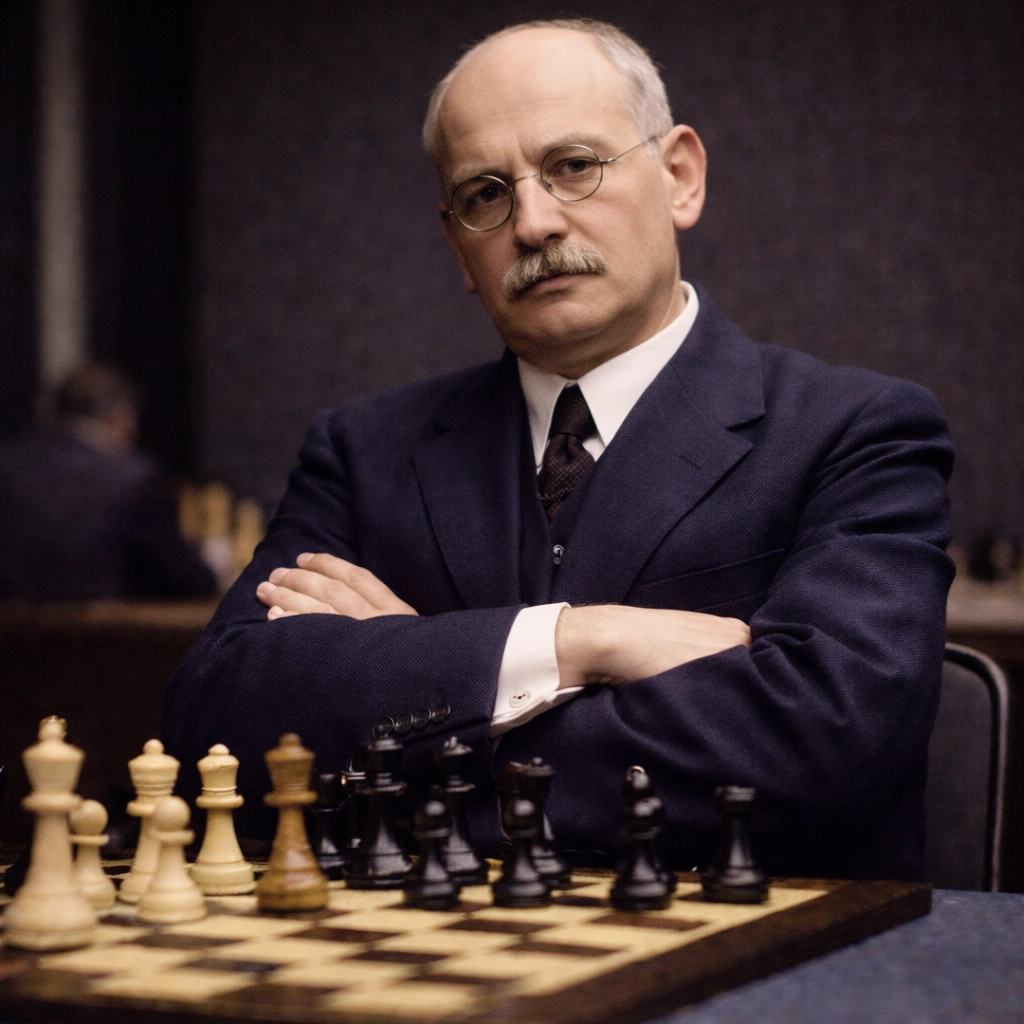
1. Introduction: who Siegbert Tarrasch was and why he is a fundamental figure
In the history of chess there are champions who win titles, geniuses who dazzle with brilliant combinations, and thinkers who change the way the game is understood. Siegbert Tarrasch belongs to a very particular category: that of the lawgivers of chess.
Tarrasch was not simply a great master of his time. He was the man who organized, systematized, and popularized the principles of classical chess. Where there had previously been scattered intuitions, he built clear rules. Where there were exceptions, he imposed norms. And where individual creativity reigned, he proposed a universal model.
For decades, thinking about chess meant thinking “in the Tarrasch way.” Even those who later rebelled against his ideas — such as Nimzowitsch — did so because Tarrasch had established such a solid framework that it deserved to be challenged.
His historical importance is enormous: without Tarrasch, modern chess would not have had such a clear starting point.
2. Chess at the end of the 19th century: the need for order and system
To understand Tarrasch’s impact, it is essential to place him in his historical context. At the end of the 19th century, chess was growing rapidly as an intellectual discipline, but it lacked a clear pedagogical doctrine.
There were great players and partial theories, but:
- the principles were not well defined,
- many ideas were transmitted orally or intuitively,
- and learning depended too much on individual talent.
Chess needed order, and Tarrasch arrived at exactly the right moment. Inspired by Steinitz’s ideas, but with a much more normative spirit, he decided to turn chess into a logical system, almost scientific.

His goal was not only to play well, but to teach how to play well. And for that, clarity, rules, examples, and conviction were needed.
3. Origins, intellectual background, and personality
Siegbert Tarrasch was not a professional chess player in the usual sense. He was a doctor, a cultured man, and deeply rational. This scientific background decisively influenced his way of understanding chess.
For Tarrasch:
- a correct position had to have a logical explanation,
- a move had to be justified by general principles,
- and chance or inspiration were not sufficient foundations.
His personality was strong, self-assured, and at times dogmatic. Tarrasch believed in his ideas with absolute conviction, which allowed him to spread them with enormous effectiveness… but also led him to underestimate alternative approaches.
This trait explains both his enormous influence and the conflicts he generated later on.
4. Tarrasch as a player: practical strength and ambition
Although today he is remembered above all as a theoretician, Tarrasch was a true elite player, one of the strongest in the world for several years. His chess was consistent with his doctrine: clear, direct, active, and based on solid principles.
He stood out for:
- excellent piece development,
- control of the center,
- well-prepared attacks,
- and great technique in simple endgames.
Tarrasch believed that, if one played correctly from the start, the game should flow naturally toward an advantage. His chess conveyed a sense of order and control, very different from the more psychological style of other contemporaries.
His ambition was enormous: he saw himself as the natural heir to the chess throne, and that conviction shaped his entire career.
5. The classical system: principles, dogmas, and clarity
Tarrasch’s greatest contribution was the clear formulation of the classical system of chess. For him, chess had to be governed by universal principles, valid in the majority of positions.
Some of his best-known dogmas were:
- “Development is more important than early material gain”
- “Rooks belong behind passed pawns”
- “Poorly placed pieces must be improved before attacking”
These principles brought enormous clarity to generations of players. For the first time, chess seemed teachable in a systematic way, almost like an exact science.
The problem (as would be seen later) was that Tarrasch tended to present these principles as absolute laws, not as flexible guidelines.
6. Development, center, and activity: the Tarraschian creed
At the heart of Tarrasch’s thinking was one central idea: the activity of the pieces. For him, a poorly developed piece was a structural weakness, regardless of the material.
He strongly defended:
- direct occupation of the center with pawns,
- rapid and harmonious development,
- coordination of pieces before any attack,
- rejection of passive or indirect maneuvers.
This approach turned classical chess into a clear and pedagogical model. For decades, learning chess meant learning these basic principles before exploring more complex ideas.
Even today, the initial training of any chess player remains deeply influenced by this creed.
7. Openings associated with Tarrasch and his theoretical vision
Tarrasch’s mark on opening theory is profound. Variations and systems that bear his name perfectly reflect his philosophy: rapid development, central control, and active play.
The Tarrasch Defense, for example, accepts structural weaknesses in exchange for piece activity, something that for Tarrasch was perfectly logical: an active piece can compensate for positional defects.
For him, openings were not traps or forced memorization, but practical applications of general principles. If an opening allowed the pieces to develop well and fight for the center, it was correct.
This approach decisively influenced how openings were studied for decades.
8. Tarrasch as a pedagogue and popularizer
Perhaps no other aspect of his legacy is as important as his role as an educator. Tarrasch wrote, taught, and popularized chess with extraordinary clarity.
His texts not only explained what to play, but why to play it. They had a didactic, authoritative, and confident tone that proved extremely effective for thousands of players.
Thanks to Tarrasch, chess ceased to be an almost esoteric body of knowledge and became an accessible discipline, with clear rules and learning methods.
Even today, many basic concepts taught to beginners come directly from his work.
9. Intellectual rivalries and historic confrontations
Tarrasch’s figure cannot be separated from the great intellectual rivalries of his time. Unlike other masters who competed mainly on the board, Tarrasch also fought on the terrain of ideas. For him, chess was not just a practice, but a doctrine that had to prevail.
His most intense confrontations were not always resolved by sporting results, but by theoretical debates, articles, books, and public statements. Tarrasch was convinced that chess had to be governed by clear and universal principles, and he defended that vision with an almost ideological firmness.
This attitude made him a polarizing figure. Admired by many for his pedagogical clarity, he was also criticized for his rigidity and for his tendency to discredit ideas that did not fit into his system. However, these rivalries were extremely productive: they forced the chess community to think, debate, and evolve.
10. Tarrasch versus Steinitz, Lasker, and Nimzowitsch
Tarrasch’s place in history is better understood by comparing him with other key figures of his era.
With Steinitz, he shared the idea that chess should be based on rational principles, but Tarrasch took that idea one step further, transforming it into a normative code. Where Steinitz was flexible and contextual, Tarrasch was categorical.
With Lasker, the contrast was even greater. Lasker represented a psychological, adaptable, and pragmatic chess, while Tarrasch defended the superiority of “correct” play over any emotional consideration. This opposition symbolizes two radically different ways of understanding competition.
The most famous clash was with Nimzowitsch. For Tarrasch, hypermodern ideas were a threat to the logical order of chess. For Nimzowitsch, Tarrasch represented a rigidity that had to be overcome. This conflict did not weaken chess: it pushed it toward a higher synthesis.
11. Strengths and limitations from a modern perspective
From today’s perspective, Tarrasch’s legacy can be analyzed with greater balance, without falling into either uncritical veneration or simplistic rejection.
Strengths
- Exceptional pedagogical clarity
- Coherent systematization of classical chess
- Enormous formative influence
- Solid principles still valid in many positions
Much of what is today considered “chess common sense” comes directly or indirectly from Tarrasch.
Limitations
- Conceptual rigidity
- Difficulty accepting exceptions to his rules
- Underestimation of indirect and prophylactic approaches
These limitations do not cancel out his greatness, but they explain why his system needed to be complemented and, in some respects, corrected by later generations.
12. Competitive decline and doctrinal rigidity
As time went on, chess evolved faster than Tarrasch was willing to accept. New ideas, new structures, and new styles began to challenge classical dogmas.
Tarrasch, faithful to his convictions, proved reluctant to modify his theoretical framework. This rigidity had practical consequences: his competitive performance began to suffer against more flexible and adaptable players.
However, this decline should not be interpreted as a failure, but as a natural historical transition. Tarrasch had fulfilled his role: to establish a system. The next stage consisted of expanding it, questioning it, and enriching it.
His resistance to change is, paradoxically, proof of the strength of his convictions.
13. Tarrasch’s influence on later generations
Few chess players have influenced the training of later players as much as Tarrasch. For decades, his principles were taught as fundamental truths.
Even the grandmasters who later rebelled against his doctrine did so from within the system he had created. To break the rules, one first had to know them, and Tarrasch took care to define them precisely.
His influence is especially visible in:
- the teaching of basic and intermediate chess,
- the importance of development and activity,
- the evaluation of pawn structure,
- the technique of simple endgames.
In this sense, Tarrasch is one of the great founders of modern pedagogical chess.
14. What a chess player can learn from Tarrasch today
Studying Tarrasch remains extremely useful, as long as it is done with a critical and contextualized perspective.
Some key lessons:
- The importance of clear principles as the basis of play.
- The value of development and piece activity.
- The need for order and coherence in the position.
- The usefulness of general rules for making practical decisions.
- The danger of turning principles into immovable dogmas.
Tarrasch teaches both what to do and what not to do when a rule is confused with an absolute law.
15. Tarrasch in the history of chess
Historically, Siegbert Tarrasch occupies an absolutely central place. He was not the most brilliant champion nor the boldest innovator, but he was the great organizer of chess thought.
Without him, chess would have lacked a solid pedagogical framework for decades. With him, the game became accessible, teachable, and structured.
Tarrasch represents the moment when chess passed from being an art dominated by individual geniuses to becoming a discipline with rules, principles, and method.
16. Conclusion: the man who imposed rules on chaos
Siegbert Tarrasch was, above all, a builder of order. In a chess world that was growing rapidly and threatened to disperse into contradictory styles, he imposed clarity, system, and coherence.
His legacy is not in immortal combinations or world titles, but in something more enduring: a way of teaching and understanding chess. Even those who surpassed him did so thanks to the fact that he had prepared the ground.
For that reason, Tarrasch is not just another historical figure. He is the lawgiver of classical chess, the man who turned intuitions into rules and chaos into system.
And as long as chess continues to be taught, discussed, and evolved, his influence will remain alive.