
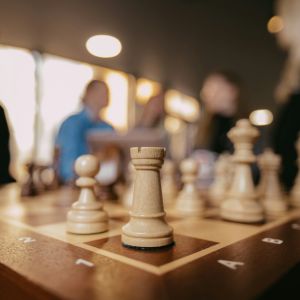
The World Chess Championships not only determine who the best player of each era is, they also establish material references that influence clubs, tournaments, and players around the world. The pieces used in these events are not chosen at random: they follow very specific criteria of clarity, proportion, stability, and neutrality.
Analyzing which pieces have been used in World Championships helps to understand what is considered “ideal equipment” in high-level chess, and why certain designs have endured while others have disappeared.
In this article, we review the most relevant historical sets, current models, and the practical reasons behind their selection.
The early periods: traditional pieces and lack of standardization
In the early World Championships, chess was not yet fully standardized. Pieces varied greatly depending on the country, the organizer, and the historical moment. It was common to see highly ornamented pieces, with local designs and inconsistent proportions.
These pieces reflected the cultural traditions of each place, but they also created problems: visual confusion, differences between boards, and uneven playing experiences. As competitive chess grew, these limitations became evident.
The World Championship was one of the settings where the need for a common standard became most clearly visible.

The consolidation of Staunton in World Championships
Over time, the Staunton design also became established in World Championships. Its visual clarity and neutrality made it ideal for high-level games, where any distraction can be decisive.
Staunton allowed players from different cultures to sit down and play without the need for prior adaptation. This became especially important as chess internationalized and championships were followed across different countries.
From that point on, Staunton—or very faithful variants—became the basis for virtually all sets used in World Championships.
Proportion, stability, and visibility as priorities
In elite chess, pieces must serve a very clear function: not interfering with the game. That is why sets used in World Championships prioritize stability, balance, and proportion with the board.
Pieces usually have wide bases and good balance, and a size that allows them to be clearly distinguished even from a distance. This is important not only for players, but also for arbiters, photographers, and broadcasts.
The design should visually disappear so that the focus remains on the game.
Iconic sets and recognizable models
Over the years, some sets used in World Championships have become iconic—not because they are extravagant, but because they represent the ideal of a functional piece: sober, balanced, and perfectly recognizable.
These sets have directly influenced what is now considered “standard” equipment in clubs and tournaments. Many manufacturers take these proportions and profiles as a reference when developing their competition models.
In this way, the World Championship acts as both a laboratory and showcase of well-designed chess equipment.
Pieces in the modern era of the World Championship
In more recent championships, the approach is even more technical. Pieces are selected with consideration for:
- live broadcasting
- artificial lighting
- cameras and close-ups
- uniformity across boards
This has reinforced the use of very clear Staunton designs, with well-defined contrasts and finishes that do not excessively reflect light.
Aesthetics remain important, but always subordinated to functionality.
Why “special” or themed pieces are not used
Despite the prestige of the event, themed or experimental designs are not used in the World Championship. This is deliberate. The goal is to avoid any element that could distract or psychologically influence the players.
The equipment must be neutral and familiar, so that neither player feels they are competing in a strange or uncomfortable environment.
This neutrality is one of the keys to elite chess.
What players can learn from these sets
For amateur or club players, observing which pieces are used in World Championships offers a clear lesson: the best equipment is not the most eye-catching, but the one that best supports the game.
Choosing pieces with similar proportions, good balance, and a sober design brings the home playing experience closer to that of professional chess.
Conclusion
The pieces used in World Chess Championships are not meant to stand out, but to disappear so that the game becomes the main focus. Throughout history, this has led to the consolidation of clear, balanced, and universal designs.
Understanding why these sets are chosen helps players make better decisions and appreciate the importance of well-designed equipment in high-level chess.


