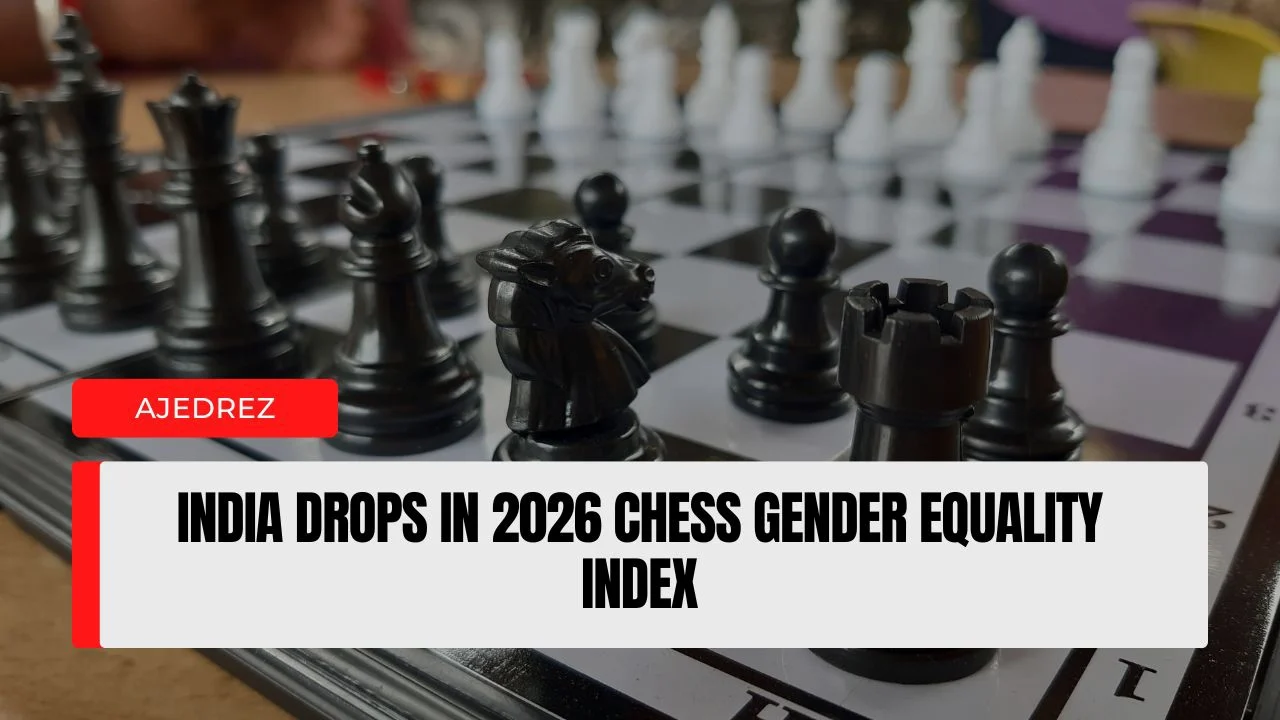
India has slipped in the 2026 Chess Gender Equality Index, an international ranking designed to evaluate the level of female participation within competitive chess. The country’s decline in this assessment has sparked renewed discussion within the chess community about the structural challenges that still affect the growth of women’s chess.
The index evaluates several indicators related to gender balance in chess, including the number of registered female players, participation in official tournaments, the acquisition of international titles and access to structured training programs. Based on these factors, a global ranking is compiled to provide an overview of how women’s participation in chess is evolving across different countries.
India’s drop in the rankings has prompted analysis among coaches, organizers and federation officials, who are now examining which measures could help strengthen female participation in the national chess scene.
The Chess Gender Equality Index evaluates multiple indicators of female participation in international competition
The Chess Gender Equality Index has become an important reference for assessing women’s representation within the global chess ecosystem. The ranking is based on the analysis of several variables that reflect the presence of women in competitive chess.
Among the indicators considered are the number of registered female players in each national federation, the proportion of women participating in official tournaments and the visibility of female players in international rating lists.
The index also evaluates the number of international titles achieved by women and their participation in high-level tournaments. These factors together provide a broader picture of the level of gender equality within the competitive chess environment.
The primary aim of the index is not only to rank countries but also to identify areas where development policies could help improve opportunities for female players.
India’s drop in the ranking highlights structural challenges in the development of women’s chess
India’s decline in the index has been interpreted as a sign that certain structural obstacles still affect the expansion of women’s chess in the country. Although India has experienced remarkable growth in the chess world over the past decade, that progress has not always translated into proportional increases in female participation.
Specialists within the chess community have noted that one of the key challenges lies in early access to competitive training programs. Developing young talent is widely considered a crucial element in strengthening women’s presence on the international chess circuit.
Another aspect frequently mentioned is the need to expand competitive opportunities for young female players, allowing them to gain experience and progress toward higher levels of competition.
Training programs and early talent development play a decisive role in strengthening women’s chess
One of the most frequently discussed factors in the debate surrounding the index is the importance of structured training programs in the development of female chess players. Identifying talent at an early stage and providing access to high-level coaching can significantly influence a player’s progress.
In several countries that have improved their position in the index, the growth of women’s chess has been closely linked to organized development programs. These initiatives often include specialized academies, youth tournament circuits and long-term coaching support for promising players.
Creating a competitive environment where young players can gain experience in tournaments allows them to develop the skills necessary to compete at higher levels of chess.
National federations play a key role in promoting equality initiatives within competitive chess
National chess federations are central to implementing policies designed to improve gender balance within the sport. The organization of dedicated tournaments, the development of training programs and support for emerging female players are among the initiatives used in various countries.
The international system of chess titles and competitions is regulated by FIDE, the governing body responsible for overseeing competitive chess at a global level.
Within this institutional framework, national federations have the capacity to promote initiatives aimed at increasing female participation, including training scholarships, development programs and competitive opportunities designed for young players.
Greater visibility for women’s chess is considered essential to inspire new generations of players
Another aspect highlighted in the analysis of the index is the importance of media visibility for women’s chess. Coverage of tournaments, recognition of achievements and the promotion of successful female players can play a significant role in encouraging new generations to enter the sport.
When young players have visible role models within the international chess circuit, the game becomes a more accessible and attractive path to pursue competitively.
The growth of women’s chess depends not only on institutional initiatives but also on the broader ecosystem surrounding the sport. Media exposure and recognition of achievements can help increase interest in women’s participation in competitive chess.
The debate sparked by the index opens a wider discussion about the future of women’s chess in India
The publication of the 2026 Chess Gender Equality Index has opened a broader discussion within the Indian chess community. The country’s drop in the ranking has highlighted the need to continue developing strategies that strengthen female participation at every level of competition.
Experts agree that long-term progress in women’s chess requires a combination of structured training, increased competitive opportunities and greater visibility within the international chess scene.
In this context, the analysis triggered by the index not only highlights current challenges but also encourages reflection on how to build a more inclusive and balanced environment within competitive chess in the years ahead.