
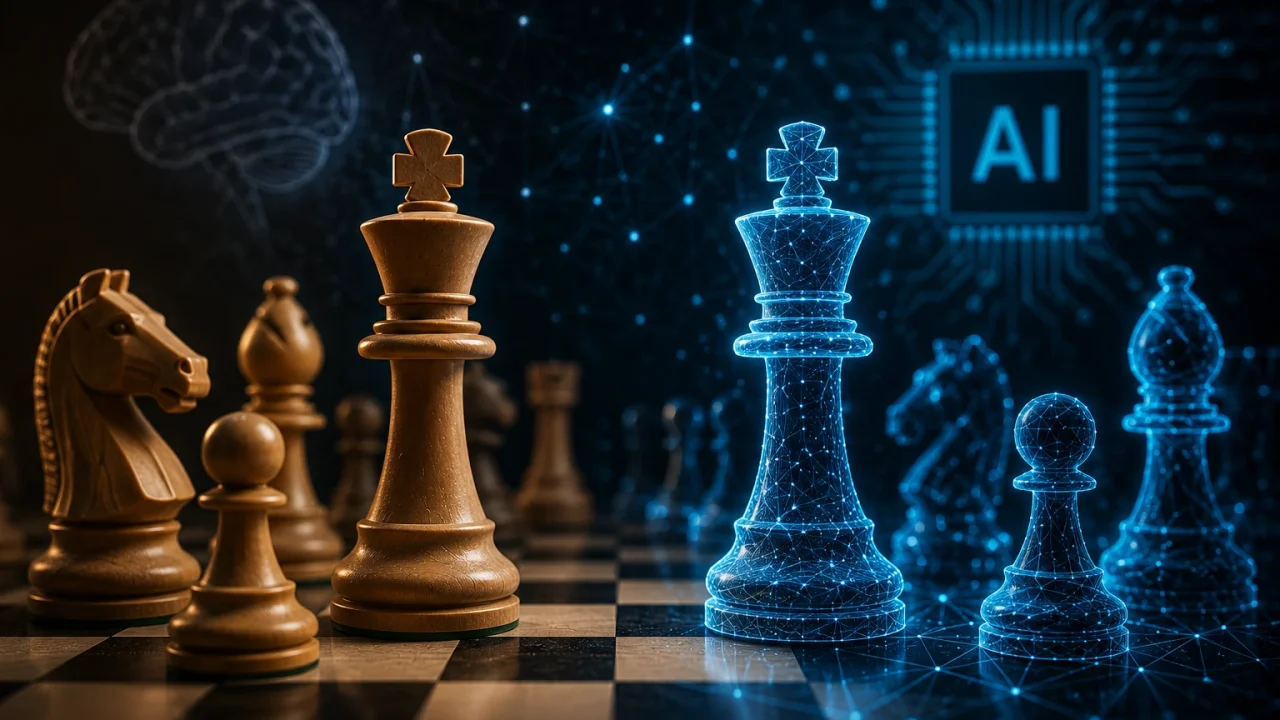
For decades, improving at chess meant sitting in front of a board, spending hours analyzing games, and gradually learning through experience. That process still exists today, but a new force has quietly reshaped the game in ways few people could have predicted: artificial intelligence.
The remarkable part is that this revolution has happened almost unnoticed. The rules haven’t changed. The pieces still move the same way. The essence of chess remains untouched. Yet behind the scenes, AI has fundamentally transformed how players study, train, and understand the game.
Millions of chess enthusiasts now rely on AI-powered tools every day, often without giving them a second thought. But behind those instant recommendations lies one of the most significant changes in modern chess history.
From hours of analysis to answers in seconds
Not long ago, reviewing a single chess game could take an entire afternoon.
Players compared different variations.
Looked for hidden mistakes.
Consulted books.
Discussed ideas with training partners.
Today, the process takes only seconds.
Modern chess engines instantly identify critical moments.
Highlight important mistakes.
And suggest alternatives that often surprise even experienced players.
Learning from every game has become dramatically faster.
A completely new way of understanding chess
Artificial intelligence hasn’t simply found stronger moves.
It has changed the way people think about chess itself.
For decades, many strategic principles were considered almost unquestionable.
Now, engines regularly reveal positions where breaking those principles is actually the strongest choice.
Unexpected sacrifices.
Highly unconventional moves.
Plans that few human players would have considered years ago.
As a result, modern chess has become richer and more creative than ever before.
Learning has become far more accessible
Perhaps one of AI’s greatest contributions is making high-quality training available to almost everyone.
In the past, having a strong coach often made the biggest difference.
Today, any player can analyze games using powerful software.
Receive detailed feedback.
Discover recurring mistakes.
And prepare new ideas from home.
Technology hasn’t replaced human coaching.
But it has removed many of the barriers that once limited improvement.
The key point: AI doesn’t play the game for us
One common misconception is that artificial intelligence makes learning effortless.
The reality is exactly the opposite.
Chess engines provide answers.
Understanding those answers still depends entirely on the player.
Research into learning consistently shows that knowledge becomes lasting only through active understanding.
Copying the strongest move isn’t enough.
Players must understand why it works.
What strategic idea lies behind it.
And when the same concept can be applied again.
That is why the players who improve the most are not necessarily those who use AI the most.
They are the ones who ask better questions and learn how to interpret the answers.
Artificial intelligence accelerates learning.
It does not replace it.
Training has entered a new era
Preparation today looks very different from what it did twenty years ago.
Many players combine traditional study with AI-assisted analysis.
They prepare opening ideas.
Review mistakes.
Test new concepts.
And explore positions that would once have required enormous amounts of manual analysis.
Training has become more efficient.
At the same time, it requires better judgment to separate useful information from unnecessary complexity.
Its influence extends far beyond elite players
Artificial intelligence is often associated with grandmasters.
In reality, everyday club players benefit just as much.
Beginners now have access to analytical tools that were once available only to professionals.
They can correct mistakes immediately.
Track their progress.
And improve far more efficiently than previous generations.
AI has significantly narrowed the gap between newcomers and experienced players.
Has chess really changed?
Curiously, the game itself remains exactly the same.
The rules haven’t changed.
The board still has sixty-four squares.
The pieces move exactly as they always have.
What has changed is our ability to understand increasingly complex positions.
Artificial intelligence hasn’t replaced chess.
It has expanded the way we see it.
The final move
Perhaps the greatest impact of artificial intelligence isn’t that it helps players find stronger moves.
Perhaps it’s that it has transformed the way people learn.
Analyze.
And develop their thinking over the board.
In the end, chess engines can point toward the best path.
But only the player can truly understand it.
And that partnership between human intelligence and artificial intelligence is quietly shaping the next chapter in the history of chess.


