
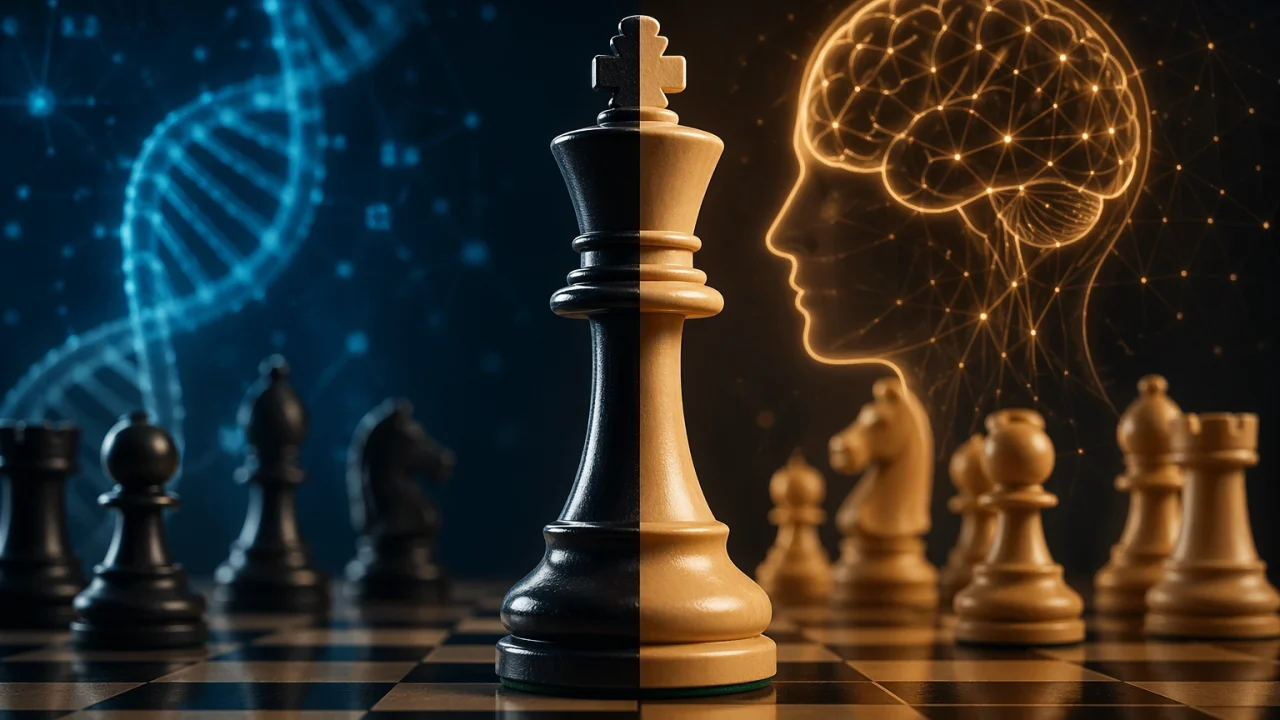
Are great chess players born or made? It’s a question that keeps coming up every time someone spots a brilliant move in seconds. When elite players seem to “see” the board differently, it’s tempting to assume they were simply born that way. But science tells a more nuanced (and far more interesting) story.
A game that pushes the brain to its limits
At first glance, chess looks like pure intelligence. Two players, 64 squares, and a battle of minds. But what actually happens during a game goes far beyond just being “smart.”
Strong players rely on memory, sustained focus, pattern recognition, calculation, and emotional control—all at once. It’s not just about knowing how pieces move. It’s about making decisions under pressure, anticipating your opponent, and adapting in real time.
That’s why chess has become a favorite subject in cognitive research. It offers a unique window into how the brain handles complex problem-solving.
Studies comparing experts and beginners reveal something surprising. Top players don’t always calculate more moves ahead. Instead, they recognize familiar patterns faster. They see meaning in positions that others perceive as chaos.
It looks like talent. But in many cases, it’s experience at work.
Genetics matters, but it doesn’t decide the outcome
This is where the debate gets more complicated. Yes, genetics can play a role in abilities that matter for chess.
Traits like working memory, concentration, processing speed, and even stress tolerance have some biological basis. Not everyone starts from the same point. Some people may find it easier to learn quickly or stay focused for long periods.
That advantage is real.
But it’s not destiny. A favorable genetic setup doesn’t turn someone into a grandmaster on its own. And lacking an obvious edge doesn’t prevent someone from reaching a high level.
Genes can open the door. They don’t walk you through it.
Training changes more than you think
If there’s one point most experts agree on, it’s the power of deliberate practice.
Playing casually isn’t enough. Improvement comes from studying openings, reviewing games, analyzing mistakes, solving puzzles, and training specific positions again and again.
Over time, the brain adapts.
Skills that seem innate, like intuition or “board vision”, are often built through repetition. Pattern recognition improves. Decision-making becomes faster. Positions start to “make sense” more quickly.
This is why so many top players start young. Not necessarily because they were born prodigies, but because they begin accumulating thousands of hours of focused practice earlier than others.
In chess, as in music or sports, exposure matters. A lot.
The real question: talent or hard work?
So what matters more?
The most honest answer is: both.
Genetics can influence how quickly someone progresses. It can make learning smoother or more efficient. But training remains the foundation of high-level performance.
In other words, talent might speed things up, but it doesn’t replace the work.
There’s also a common misconception worth addressing. What people call “talent” is often the result of early exposure, discipline, and relentless curiosity. From the outside, it looks effortless. From the inside, it’s usually years of quiet, consistent effort.
That doesn’t eliminate natural ability. It simply puts it into perspective.
What really sets the best apart
When you look at elite players, there’s no single blueprint. Some stand out for their memory. Others for intuition. Others for calmness under pressure.
But one trait shows up again and again: extreme dedication.
Top players don’t just play chess. They live it. They analyze positions deeply, revisit mistakes, and constantly look for ways to improve.
There’s also something harder to measure: motivation. The willingness to keep going after losses. The patience to study when progress feels slow. The drive to understand positions more deeply than everyone else.
That mindset is part of what builds excellence.
A debate that’s far from over
Science doesn’t offer a simple yes-or-no answer—and it probably never will.
Chess ability, like most complex skills, sits at the intersection of nature and nurture. Genetics, training, environment, age of exposure, and mindset all play a role.
There’s no single formula. No guaranteed path.
The final move
Maybe the real question isn’t whether chess talent is genetic.
Maybe it’s what you do with the abilities you have.
Chess doesn’t just reward those who are “gifted.” It rewards those who stay longer with a position, who keep analyzing when others stop, who come back after defeat and try again.
And in that space (between what you’re given and what you build) is where many games are truly decided.


