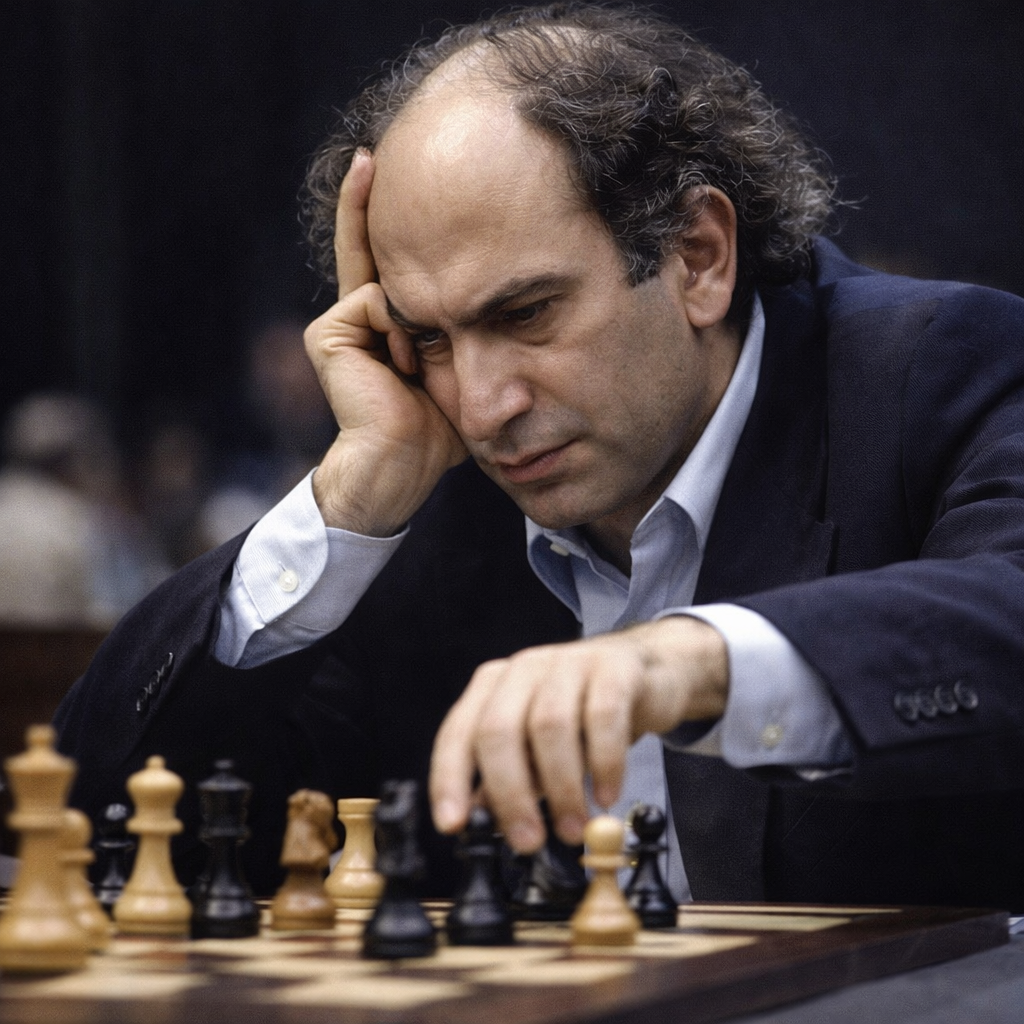
1. Introduction: who Mikhail Tal was and why he remains eternal
Talking about Mikhail Tal is talking about chess as spectacle, risk, and artistic creation. Tal was not simply world champion: he was the player who demonstrated that imagination could prevail over pure logic, even at the most demanding elite level.
His figure is eternal because:
- he changed the way attack was conceived,
- he brought emotion and romanticism back to modern chess,
- and he showed that psychological value can be as decisive as objective evaluation.
Tal did not play only against the board: he played against the opponent’s mind. And on that terrain, he was one of the most dangerous who have ever existed.
2. Chess before Tal: logic, calculation, and creative limits
Before Tal, Soviet chess was moving toward a hyper-rationalization of the game. Precise calculation, objective correctness, and strategic discipline were the dominant pillars.
Although creativity existed, it was:
- channeled,
- limited by theoretical dogmas,
- and subordinated to safety.
Tal appears as a frontal rupture. He does not reject calculation, but combines it with intuition, sacrifice, and constant imbalance. Historically, Tal returns chess to a forgotten question:
what if the opponent cannot defend even if the position “holds”?
3. Origins, childhood, and an extraordinary talent
From childhood, Mikhail Tal showed an instinctive relationship with chess. He did not only learn lines; he understood patterns, invisible threats, and hidden dynamics.
In his childhood one can see:
- an extraordinary imagination,
- a natural ease for tactical calculation,
- and a total absence of fear of mistakes.
Tal was not trained as a methodical technician, but as a creator of constant problems. This way of thinking, developed from a young age, explains why his chess remains so difficult to imitate even today.
4. Meteoric rise and arrival at the Soviet elite
Tal’s rise was rapid and, for many, bewildering. In an extremely competitive Soviet environment, Tal began defeating established grandmasters playing a radically different kind of chess.
During this stage:
- he sacrificed material without fear,
- he created complications impossible to calculate completely,
- and he forced his rivals to make decisions under constant pressure.
Historically, this rise shows that the Soviet system, despite its rigidity, could not ignore such overflowing talent.
5. Tal as a player: attack taken to the extreme
To define Tal’s style is to speak of permanent attack, but not blind attack. Tal knew exactly what he was sacrificing: clarity in exchange for initiative, material in exchange for uncertainty.
His attacks are characterized by:
- constant pressure on the king,
- an accumulation of threats,
- positional and tactical sacrifices,
- and an exceptional command of chaos.
Tal did not need a forced combination: it was enough for him to create enough problems for the opponent to collapse. This philosophy redefines the concept of chess correctness.
6. Sacrifice as a chess language
For Tal, sacrifice was not a brilliant exception, but a habitual language. He sacrificed:
- pawns to open lines,
- pieces to destroy coordination,
- material to gain time and confusion.
Many of these sacrifices were not completely correct from a cold point of view, but they were practically impossible to defend. Historically, Tal shows that chess is not played only with numbers, but with human beings.
7. Competitive psychology: intuition, courage, and controlled chaos
Tal’s psychology is inseparable from his chess. He played with absolute confidence in his intuition, even when the position became objectively dubious.
His psychological traits include:
- extreme courage,
- an extremely high tolerance for risk,
- and a unique ability to make the opponent uncomfortable.
Tal understood that many players play worse under pressure, and he built his games to maximize that effect. In this sense, he was one of the greatest psychologists in competitive chess.
8. Tal as world champion and symbol of creative freedom
When Tal became world champion, he did so representing everything chess can be when it is freed from fear.
As champion:
- he legitimized sacrifice as a strategic weapon,
- he demonstrated that creativity can defeat absolute control,
- and he made it clear that chess is also emotion.
Historically, Tal symbolizes the victory of imagination over orthodoxy, even if that victory is neither eternal nor stable.
9. Sporting results and international titles
The record of Mikhail Tal is as brilliant as it is irregular, and precisely for that reason it is profoundly human. Tal was not a champion of prolonged domination or stable hegemony; he was a player of extremely high peaks, capable of extraordinary performances even in adverse circumstances.
Throughout his career he accumulated:
- victories in top-category tournaments,
- memorable performances against the world elite,
- and unanimous respect even among direct rivals.
Beyond the specific titles, what is truly significant is the quality of his victories. Many of his games not only gave him points, but defined an era, becoming essential references for attacking chess. Historically, Tal shows that a player’s impact is not always measured by the number of trophies, but by the creative mark he leaves behind.
10. The World Championships and the great matches
Tal’s relationship with the World Championships is one of the most fascinating in history. His arrival at the title was explosive, almost poetic: a young irreverent player defeating established orthodoxy with imagination and courage.
In title matches:
- Tal pushed risk to the limit,
- he forced unbalanced positions from the earliest stages,
- and he tested the psychological endurance of his rivals.
However, his reign also showed the structural limitations of such a physically and mentally demanding style. Tal paid a high price for always playing on the edge. Historically, these matches teach that elite chess is a delicate balance between creativity and sustainability.
11. Tal against the great champions of his era
Tal faced some of the strongest champions and challengers who have ever existed, and he did so without changing his essence. Against more technical or defensive players, Tal did not adapt: he forced the opponent to adapt to him.
In these duels:
- he created chaos even in apparently quiet positions,
- he induced errors through constant pressure,
- and he exploited any psychological doubt.
Many great champions acknowledged that playing against Tal was a deeply uncomfortable experience. Not because he was objectively invincible, but because he did not allow a “normal” game. Historically, this destabilizing effect is one of the marks of great geniuses.
12. Strengths and weaknesses from a modern perspective
Modern analysis of Tal’s chess, with the help of engines, has qualified—but not disproved—his legend. It is true that some of his sacrifices do not withstand a cold evaluation, but it is also true that many were surprisingly correct.
Strengths
- Extraordinary ability to generate initiative
- Tactical intuition out of the ordinary
- Deep understanding of dynamic positions
- Superior competitive psychology
- Constant creativity under pressure
Weaknesses
- Excessive risk in objectively equal positions
- Dependence on the initiative to sustain the position
- High physical and mental wear
Historically, these weaknesses do not diminish his figure: they define it. Tal consciously chose to play on the most dangerous ground, and he accepted its consequences.
13. Myths, exaggerations, and the objective reality of his chess
Many myths have been built around Tal: that he played “without calculating,” that he sacrificed at random, that he relied only on luck. Nothing could be further from the truth.
Tal:
- calculated deeply, though selectively,
- understood which sacrifices were practical even if not perfect,
- and knew exactly which types of positions favored his style.
The myth arises because his chess broke with the dominant narrative. Historically, Tal shows that objectivity is not the only valid criterion in competition: practicality also wins championships.
14. What a chess player today can learn from Mikhail Tal
Tal’s practical legacy is immense and remains relevant even in the engine era.
Key lessons:
- Initiative has real value, even in the long term.
- Sacrifice can be a strategic tool, not only a tactical one.
- Psychological pressure decides many games.
- Playing without fear expands creative options.
- Chess is also emotion and personal expression.
Tal teaches that daring is, at times, the best way to progress as a player.
15. Mikhail Tal in the history of chess
Historically, Mikhail Tal occupies an absolutely unique place. He was not the most enduring champion nor the most technical, but he was one of the most influential and inspiring.
He represents:
- the vindication of chess as art,
- the occasional victory of imagination over logic,
- and the idea that the game can be beautiful even in error.
His influence is felt not only in the elite, but in millions of amateurs who discovered chess through his games.
16. Conclusion: legacy, magic, and fearless chess
Mikhail Tal was a champion who played as no one else dared, and that is precisely why he is still remembered with such intensity. His chess did not seek eternal perfection, but the emotional truth of the moment.
His legacy is built on:
- immortal games,
- a philosophy of conscious risk,
- and a deep connection with the human side of the game.
In the history of chess, Tal occupies the place of the poets, those who show that the board can also be a stage for imagination, courage, and beauty. His message remains valid:
without risk, there is no magic.