
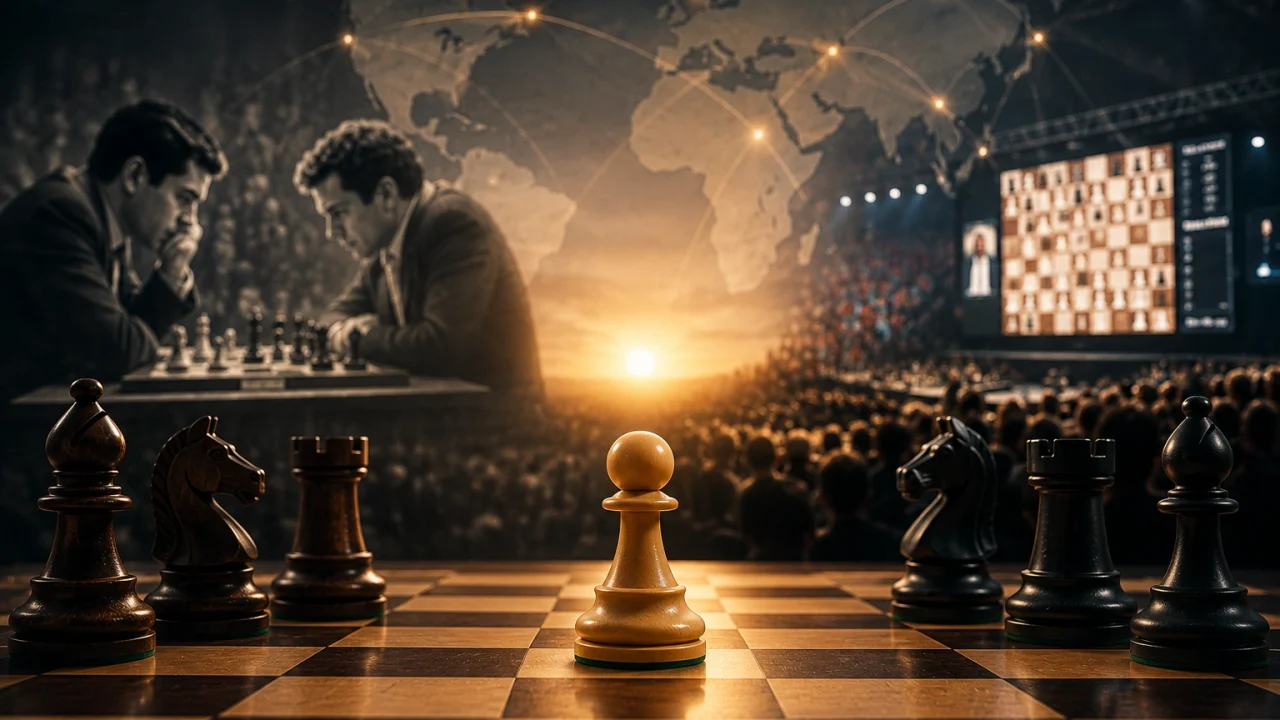
Some moments redefine an entire sport. They aren’t always the greatest victories or the most spectacular games. Sometimes, a single event is enough to change how millions of people see a game forever.
Chess has one such moment. Decades later, it is still remembered not only because it influenced the outcome of a World Championship, but because it transformed the way the world perceived the game itself. From that point on, chess was no longer viewed simply as a pastime for specialists—it became a global phenomenon.
When the world started watching the chessboard
For much of the twentieth century, chess already enjoyed enormous prestige.
Grandmasters were admired throughout the chess community.
Yet the game remained relatively niche for the general public.
Everything changed when a World Championship match captured the attention of millions of people across the globe.
For the first time, the games fascinated far more than dedicated chess fans.
Newspapers covered every move.
Television broadcasts followed each round.
People who had never played chess suddenly found themselves invested in the outcome.
Chess had officially entered the global spotlight.
More than a battle for the world title
What made that historic moment so extraordinary wasn’t only the quality of the games.
Behind the board stood two completely different visions of chess.
Two contrasting personalities.
Two opposing styles.
Every move seemed to represent something far greater than a strategic decision.
Spectators weren’t simply waiting to discover who would become champion.
They wanted to see which philosophy of chess would prevail.
That transformed every game into an event unlike anything the chess world had experienced before.
The impact was immediate
The effects of that championship were almost instant.
Sales of chess sets increased dramatically.
Chess books quickly sold out.
Thousands of clubs welcomed new players.
Children around the world asked to learn the game for the first time.
Interest spread even to countries where chess had rarely received media attention.
Few sporting events have inspired such a widespread surge in popularity.
A new era of preparation
The championship also transformed professional chess itself.
Preparation became more important than ever.
Studying opponents.
Searching for opening innovations.
Analyzing thousands of positions.
These practices gradually became essential parts of elite competition.
The overall standard of play rose significantly.
Many methods that today’s professionals consider routine began taking shape during that period.
The key question: success is never built on talent alone
One of the greatest lessons from that historic moment remains just as relevant today.
Many people tried to explain the players’ success simply by pointing to natural talent.
The reality was far more complex.
Modern research into learning suggests that extraordinary performance depends on many different factors.
Deliberate practice.
Years of accumulated experience.
Pattern recognition.
Psychological preparation.
The ability to adapt under constant pressure.
The brain evolves through training.
It gradually becomes faster at recognizing familiar positions and making efficient decisions.
That is why moves that appear effortless often represent the result of thousands of hours of dedicated work.
A legacy that still inspires
Decades later, that championship continues to appear in documentaries, books, and conversations among chess enthusiasts.
Not simply because it crowned a world champion.
But because it transformed the game itself.
Every new generation discovers those games.
And every generation continues finding new lessons within them.
Very few sporting moments possess that kind of lasting influence.
Chess was never the same again
After that historic confrontation, the public image of chess changed dramatically.
It was no longer viewed merely as an intellectual pastime for a select few.
Instead, it became a global spectacle capable of captivating millions of viewers.
Sponsors became increasingly interested in major tournaments.
Media coverage expanded.
World champions became internationally recognized public figures.
A completely new era had begun.
The final move
Perhaps the moment that changed chess forever wasn’t simply about deciding a World Champion.
Perhaps its greatest achievement was changing the way the world looked at the game itself.
It proved that behind sixty-four squares could exist drama, tension, rivalry, and unforgettable human stories.
That legacy still lives on today.
Because some moments end when the final move is played.
Others continue shaping history for generations.


