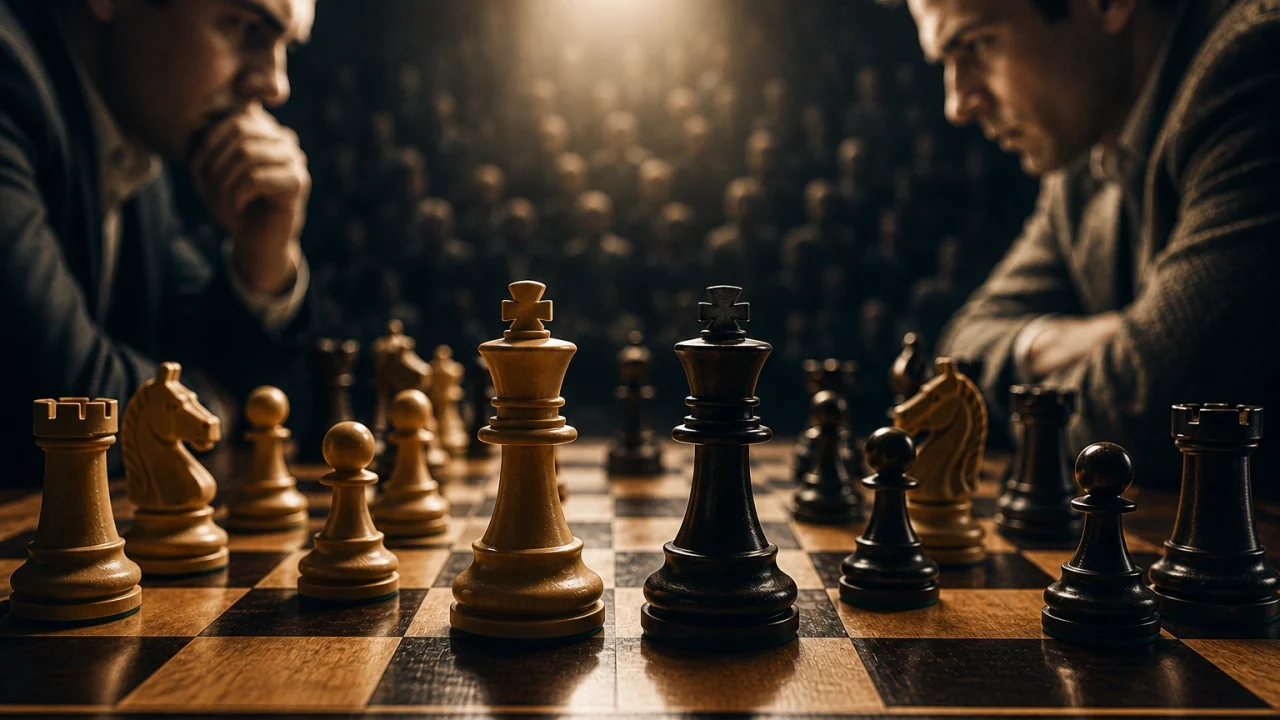
Some matches crown a champion. Others redefine an entire sport.
Chess has one confrontation that is still remembered decades later, not simply because of who won, but because it represented the collision of two completely different visions of the game. It was a battle that went far beyond the chessboard and became a symbol of its era.
This wasn’t just a contest between two extraordinary players. It was a clash of styles, ideas, preparation, and personalities. Millions followed every game as if it were a major political or cultural event. In many ways, it truly was.
When chess became more than a sport
By the middle of the twentieth century, chess had already earned worldwide respect.
But very few events had captured the attention of the general public.
Everything changed when two world-class champions with completely opposite personalities met for the world title.
Interest quickly spread far beyond the chess community.
Newspapers featured the match on their front pages.
Television programs analyzed every game.
People who had never played chess before suddenly became fascinated by the championship.
For the first time, chess had become a global headline.
Two completely different ways of playing
What made this confrontation so extraordinary was the sharp contrast between its two protagonists.
One represented discipline, meticulous preparation, and the dominance of a system that had produced champions for decades.
The other challenged every convention.
His style was unpredictable.
He took risks when nobody expected it.
He deliberately sought complicated positions and questioned many of the accepted principles of the time.
Every game became as much a psychological battle as a strategic one.
Finding the strongest move was only part of the challenge.
Understanding how the opponent thought became equally important.
More than a fight for the title
As the match unfolded, it became clear that the championship meant far more than a trophy.
Every victory seemed to carry significance beyond the board itself.
Chess became a worldwide media phenomenon.
Its players became internationally recognized figures, even among people who had never followed the game before.
Sales of chess sets and books increased dramatically.
Thousands of children were inspired to learn the game after watching the match.
Very few sporting events have transformed public interest so profoundly.
A new era of preparation
The confrontation also changed how players prepared for competition.
Opening analysis became more important than ever.
Studying an opponent’s style.
Searching for opening innovations.
Preparing unexpected ideas.
All of these elements began playing a much larger role.
Over time, this evolution became one of the foundations of modern professional chess.
The key question: what truly made this match historic?
Many people believe the result itself was what mattered most.
In reality, the biggest change came from something deeper.
The match proved that even the strongest traditions could be challenged.
It showed that creativity still had a place at the highest level.
And it demonstrated that preparation, confidence, and mental resilience could be just as important as natural talent.
Modern research into learning helps explain why.
Elite players don’t rely solely on innate ability.
Years of training reshape how the brain recognizes patterns, makes decisions, and solves complex problems.
That historic confrontation became a remarkable example of how experience and relentless preparation can overturn expectations.
A legacy that still shapes chess
Many of those games continue to be studied decades later.
Not only because of their quality.
But because they still teach valuable lessons about strategy, preparation, and psychology.
Ideas that now seem completely natural gained widespread attention during that championship.
Every new generation of players discovers the match as if it had been played only yesterday.
Its influence beyond the chessboard
The confrontation also transformed the public image of chess.
The game was no longer viewed as an activity reserved for specialists.
Instead, it became recognized as a competition capable of producing drama, tension, and worldwide excitement.
Media coverage of major tournaments expanded.
Sponsors became increasingly interested.
And chess entered a new period of international growth.
The final move
Perhaps the greatest legacy of that historic confrontation isn’t who lifted the trophy.
Perhaps it’s the fact that it proved a chess match could captivate the world just as powerfully as any major sporting event.
In the end, that extraordinary duel didn’t simply change the careers of two players.
It changed the way the world looked at chess.
And its influence can still be felt today, long after the final piece was played.