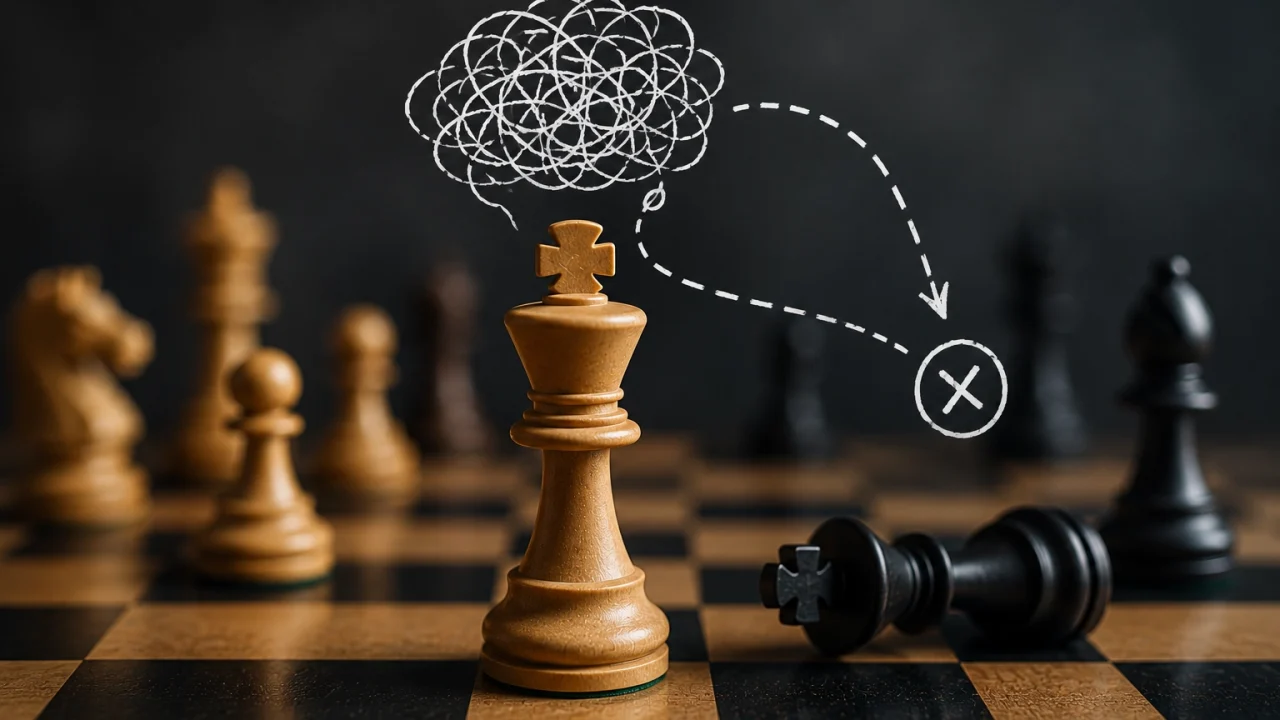
You find what looks like the perfect move. You calculate a few variations, feel completely confident, and play it without hesitation. Then, just seconds later, you realize you’ve made a terrible mistake.
Surprisingly, the problem usually isn’t a lack of chess knowledge—or even poor calculation. More often, it’s a hidden mental shortcut built into the way the human brain works. And it affects beginners, club players, and even grandmasters alike.
When your brain stops looking for answers
The human brain is designed to save energy.
Whenever possible, it searches for the quickest solution instead of examining every possibility.
In everyday life, that usually works well.
In chess, however, it can become a serious problem.
The moment we believe we’ve found a strong move, the brain experiences a small sense of satisfaction.
And that’s exactly when something dangerous happens.
It stops searching for alternatives.
The illusion of being right
Psychologists have studied this phenomenon for decades.
Once we form an initial idea, we naturally begin looking for evidence that supports it.
At the same time, we pay far less attention to information that contradicts it.
Chess is full of examples.
A player discovers what seems like a powerful attack.
They begin calculating variations.
But almost without realizing it, they focus mainly on the lines where their idea succeeds.
The uncomfortable defensive resources available to the opponent slowly disappear from their attention.
Not because they aren’t there.
But because the brain has stopped looking for them.
The mistake happens before the move
Many players believe mistakes occur the moment a piece touches the board.
In reality, they usually begin much earlier.
The error starts when we stop asking questions.
When we assume a move “has to be good.”
When we stop checking for threats.
When we convince ourselves we’ve already found the correct answer.
That’s when the most painful blunders appear.
Not because we failed to calculate.
But because we became too confident.
The importance of one final check
There is one habit that many chess coaches repeat endlessly.
Before making your move, look at the position as if you were your opponent.
It sounds almost too simple.
But it forces the brain to challenge the first idea it has already accepted as correct.
Sometimes all it takes is asking one question.
“If I were sitting on the other side of the board, how would I respond?”
That brief pause prevents an astonishing number of mistakes.
The key question: why do we all fall into this trap?
This raises an important question.
If we know this mental trap exists, why do we keep falling for it?
Because it isn’t really about chess.
It’s part of the way the human brain naturally operates.
Our minds constantly try to reduce effort.
They build patterns.
They rely on shortcuts.
They reach conclusions as quickly as possible.
Those shortcuts are extremely useful in daily life.
But in a game where a single move can completely change the outcome, they can become our biggest weakness.
Experience helps.
Strong players gradually develop routines that force them to question their own thinking.
They learn to distrust the first move that seems perfect.
That habit alone eliminates countless avoidable mistakes.
Slowing down is also a skill
Another common misconception is that stronger players simply calculate more variations.
Often, the opposite is true.
Real improvement comes from knowing when to slow down.
To review.
To verify.
To challenge your own conclusions.
The goal isn’t to spend thirty minutes on every move.
It’s to recognize the moment when your brain has stopped analyzing and has started defending an idea it already likes.
That small difference changes countless games.
A lesson that extends beyond chess
Perhaps the most fascinating part is that this mental trap doesn’t only appear over the chessboard.
It also shapes important decisions in everyday life.
When we defend our opinions.
When we solve problems.
When we believe we already know the answer before hearing all the evidence.
Chess simply makes this hidden mental process visible.
That’s one reason the game continues to fascinate psychologists and cognitive scientists who study how humans think.
Learning to doubt yourself
It sounds contradictory.
But one of the biggest improvements a chess player can make is learning not to trust every first instinct.
Not because intuition is bad.
Quite the opposite.
Strong intuition is one of the greatest strengths experienced players develop.
The difference is that they verify it.
They actively search for the move that proves their own idea wrong.
That simple habit often separates a costly blunder from a brilliant move.
The final move
Perhaps the most dangerous trap in chess isn’t a clever tactic prepared by your opponent.
Perhaps it’s the story your own brain starts telling the moment it becomes convinced it has already found the answer.
Because in the end, games aren’t always lost by the player who calculates less.
Very often, they’re lost by the player who stops asking questions too soon.
And that may be one of the most valuable lessons chess can teach—both on the board and far beyond it