Chess has produced legendary champions, unforgettable games, and brilliant moves that still amaze players today. But it has also witnessed moments so extraordinary that, had they not unfolded in front of millions of people, they would sound almost impossible to believe.
One moment, in particular, still surprises fans decades later. It wasn’t remembered because of a spectacular combination or a beautiful checkmate. Instead, it completely shattered expectations of what a World Chess Championship was supposed to look like.
It became proof that even in a game built on logic, discipline, and calculation, the human element can turn everything upside down.
When the chessboard was no longer the main story
For decades, chess had been associated with calmness and absolute concentration.
Players would sit motionless for hours.
Every gesture seemed carefully measured.
Every decision reflected complete control.
Then came a championship where everything changed.
Press conferences, disputes with tournament officials, disagreements over playing conditions, and overwhelming media attention began to overshadow the games themselves.
At times, it felt as though the real battle was happening away from the board.
The moment nobody expected
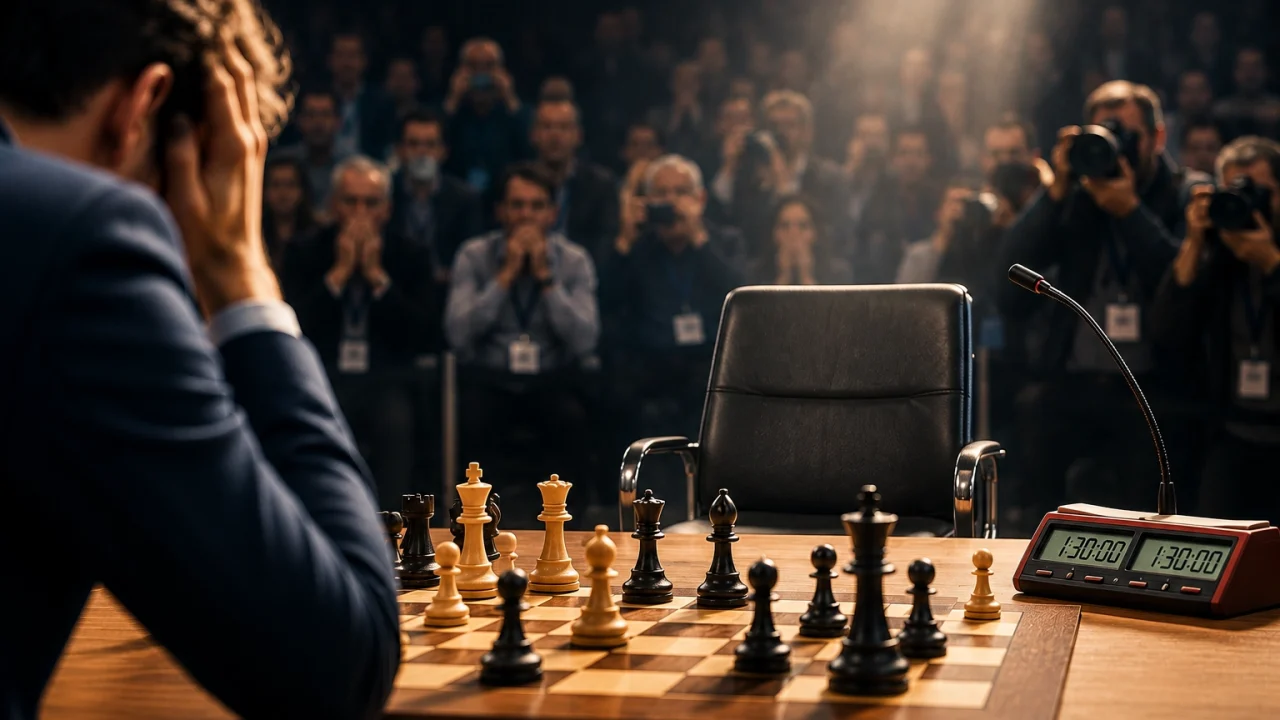
The most astonishing scene arrived when one of the players simply failed to appear for a World Championship game.
Spectators struggled to understand what was happening.
Organizers searched desperately for a solution.
Journalists tried to explain an unprecedented situation.
Meanwhile, the clock continued ticking.
The board remained perfectly set.
Television cameras focused on an empty chair.
That single image traveled around the world.
Never before had such an unusual moment attracted so much attention within the chess world.
More than a simple absence
As time passed, it became clear that this wasn’t merely an isolated protest.
It highlighted just how powerful psychological pressure can become—even for the strongest players on Earth.
Competing at the highest level isn’t only about calculating variations.
It also means dealing with enormous expectations, constant media attention, and relentless mental pressure.
That episode changed how many people viewed chess.
Behind every move stood real emotions, conflicts, and human tension.
When the entire world watched an empty board
It’s difficult to imagine a stranger sporting moment.
Thousands of spectators waiting for a game… that hadn’t even started.
Photographers pointing their cameras toward a motionless chessboard.
Commentators trying to explain a situation nobody had anticipated.
The silence itself became the story.
And that unforgettable image secured its place among the most remarkable moments in chess history.
The key question: even the strongest minds have limits
The incident also raised an important question.
Many people imagine elite grandmasters as individuals with complete emotional control.
Reality is far more complicated.
Modern science has repeatedly shown that stress, pressure, and mental fatigue affect every human brain—including those of the world’s greatest chess players.
The difference isn’t avoiding pressure.
It’s learning how to manage it.
And that ability can be trained.
Psychological preparation, experience, and years of competitive habits all help players perform under extraordinary circumstances.
But they never completely eliminate the human element.
Perhaps that’s one of the reasons chess remains so endlessly fascinating.
A turning point for the game
That extraordinary episode left a lasting impact.
Future World Championships placed much greater emphasis on tournament organization, playing conditions, and player well-being.
It also changed the public’s perception of world champions.
They were no longer viewed simply as calculating machines.
They were recognized as people carrying enormous emotional pressure.
That realization gave many fans an even greater appreciation for everything happening behind every move.
Chess creates unexpected stories
When people think about chess history, they usually remember brilliant sacrifices, unforgettable endings, or legendary champions.
Yet some of the most memorable moments have nothing to do with tactical masterpieces.
They remain unforgettable because they revealed the deeply human side of chess.
The side that never appears in engine evaluations.
The side no computer can fully predict.
The final move
Perhaps the most surreal moment in chess history wasn’t an impossible combination or a spectacular sacrifice.
Perhaps it was the realization that even in the world’s most logical game, emotions can completely reshape the course of a World Championship.
Because behind every move sits a human being.
And sometimes, more than the pieces themselves, it is those people who write the most unforgettable chapters in the history of chess.