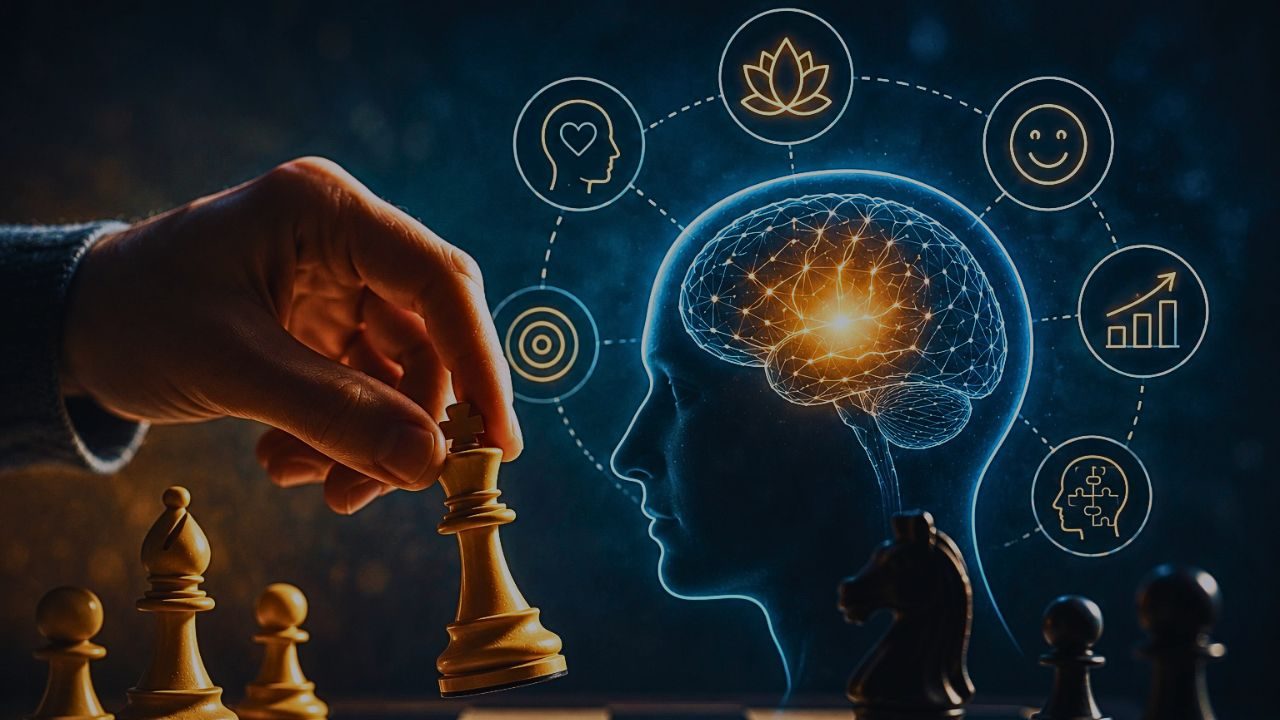
Many people start playing chess out of curiosity… and end up discovering something much deeper. It doesn’t just change the way they think. For some, it also changes how they handle stress, anxiety, and frustration.
A constant workout for the brain
Every chess game forces the mind to stay active.
Players must focus, make decisions, control impulses, and adapt to new situations in seconds.
That creates a very specific kind of mental stimulation.
Unlike passive activities, chess demands continuous engagement. There’s no real way to switch off completely. And that’s part of why the game can have such a strong psychological impact.
Many players describe the same feeling after a long game: mental exhaustion—but also mental clarity.
The board as a space for deep focus
Modern life is full of interruptions.
Notifications, screens, and constant distractions divide attention all day long. Chess works almost like the opposite.
When a game becomes intense, the brain enters a state of deep concentration. For a while, everything else fades away.
That level of sustained focus is rare in everyday life.
And for some people, that’s exactly where a sense of calm begins to appear.
The connection with anxiety
This is where things become especially interesting.
Chess can create stress during a game, particularly under time pressure or fear of losing. But outside the board, many players feel it helps organize their thoughts.
Part of the explanation may lie in how attention works.
When the brain becomes fully absorbed in solving concrete problems, repetitive thoughts temporarily lose strength.
That doesn’t eliminate anxiety. But it can reduce mental noise.
That’s why some people use chess as a form of active disconnection from everyday stress.
Learning to lose changes the mind too
There’s another side to chess that rarely gets discussed.
The game forces players to deal with mistakes.
Losing games, blundering pieces, and facing uncomfortable positions are unavoidable parts of the experience. At first, that can feel frustrating.
But over time, many players develop a different relationship with failure.
They learn to analyze mistakes without collapsing emotionally. They begin to understand that making errors is part of improvement.
That mindset often extends beyond the board.
The key question: does chess strengthen the mind—or does it depend on the player?
This is where the debate becomes more complex.
Does chess genuinely improve mental health, or does it simply attract people with certain psychological traits?
Science still doesn’t offer definitive answers.
What researchers do know is that mentally demanding activities may help keep cognitive functions active over time. Memory, attention, and planning abilities seem to benefit from regular mental exercise.
But there’s another important layer to the story.
The impact of chess depends heavily on how the game is experienced emotionally.
For some people, it can become a source of excessive stress or unhealthy obsession. For others, it creates a space for calm, learning, and mental control.
The difference isn’t only in the game itself. It’s also in the relationship each person builds with it.
The brain adapts through practice
There’s something fascinating about long-term chess training.
Over time, the brain adjusts to the kind of thinking the game requires.
Experienced players often become more comfortable with uncertainty, better at organizing decisions, and more patient in complex situations.
That doesn’t mean chess automatically turns someone into a mentally balanced person. But it can strengthen certain mental habits that are useful far beyond the board.
Especially patience.
It’s about more than intelligence
For years, chess was linked almost entirely to intelligence and calculation.
Today, the picture looks much broader.
The game also involves emotional control, mental resilience, and psychological adaptability.
Because a chess game doesn’t only test what you know. It also tests how you react when things stop going your way.
And that’s where the real battle often begins.
The final move
Maybe the connection between chess and mental health isn’t just about the game itself.
Maybe it’s about what happens inside the mind while playing.
The ability to focus deeply. To tolerate mistakes. To think under pressure without completely losing control.
Because in the end, the chessboard doesn’t only reveal how you think.
It may also reveal how you deal with chaos when there’s no obvious answer in front of you.