
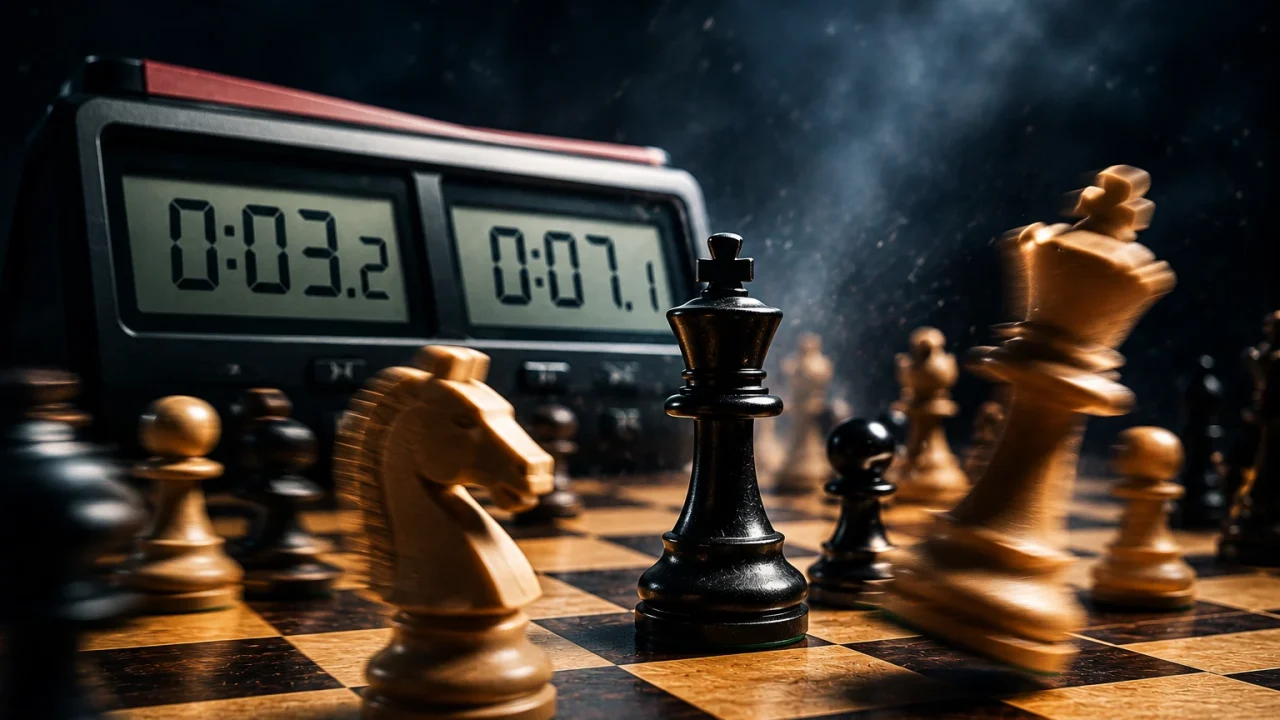
There comes a moment in certain chess games when the board is no longer the biggest challenge. The real opponent becomes the clock. Seconds disappear faster than expected, your heart rate rises, and a decision that would normally take several minutes must be made almost instinctively.
Anyone who has played a rapid or blitz game knows that feeling. Positions that looked simple suddenly become complicated. Unexpected mistakes appear with only seconds remaining. Even players capable of finding brilliant combinations in long games can blunder when time is running out.
So why does this happen? What actually changes inside the brain when the clock becomes another opponent sitting across the board?
Full article
When time changes the way you think
In a classical chess game, players have time to analyze.
Compare different variations.
Reject one idea and explore another.
Start the calculation all over again if necessary.
But once the clock starts becoming a threat, everything changes.
The brain no longer has enough time to evaluate every possibility.
Instead, it quickly narrows the options to the moves that seem most promising.
Decision-making speeds up dramatically.
And sometimes players move before they even feel they have finished thinking.
Intuition takes control
One of the most fascinating changes is the growing role of intuition.
Strong chess players don’t calculate every possible move.
Instead, they recognize patterns they have encountered hundreds—or even thousands—of times before.
That allows them to make decisions with remarkable speed.
What appears to be an instant reaction is often built upon years of accumulated experience.
The greater a player’s knowledge, the more reliable that intuition becomes.
The cost of playing fast
Speed also comes with consequences.
As available thinking time decreases, the chances of overlooking simple threats increase.
A piece is left unprotected.
A hidden checkmate suddenly appears.
A brilliant tactical sequence goes unnoticed.
In fast chess, the stronger player doesn’t always win.
Sometimes victory belongs simply to the player who makes fewer mistakes during the final seconds.
Pressure changes behavior too
It’s not only the quality of the moves that changes.
Players themselves behave differently.
Some begin moving far too quickly.
Others spend almost all of their remaining time on a single decision.
Some freeze completely.
Others seem to thrive under intense pressure.
Managing emotions often becomes just as important as calculating variations.
The key question: are some people naturally better at fast chess?
Many people assume that some players are simply born with the ability to perform well under severe time pressure.
The reality appears far more interesting.
Research into learning suggests that the brain becomes more efficient through repeated exposure to similar tasks.
Chess is a perfect example.
Players who regularly compete in rapid and blitz games gradually become faster at recognizing familiar positions.
They identify important patterns with less effort.
And they reduce the amount of time needed to make effective decisions.
Of course, individual differences exist.
Some people naturally process information more quickly.
Others remain calmer under pressure.
But experience and deliberate practice continue to play the biggest role.
That is why many elite players deliberately include fast time controls in their training.
Learning to make decisions
Interestingly, rapid chess also develops a skill that extends well beyond the board.
It teaches people how to make decisions with incomplete information.
There is never enough time to find the perfect answer.
Only enough time to choose the best option available.
The same challenge appears throughout everyday life.
Making decisions under pressure.
Accepting uncertainty.
Moving forward without having every possible answer.
Chess offers constant practice in exactly those situations.
A different kind of spectacle
Fast chess has also transformed the way audiences experience the game.
The pace is relentless.
Mistakes appear more frequently.
Endgames become dramatic races against the clock.
The tension lasts until the very final move.
That excitement explains why rapid and blitz events continue attracting larger audiences every year.
They combine high-level chess with unpredictability in a way few other formats can match.
It’s about much more than speed
At first glance, fast chess may seem like nothing more than moving pieces before the opponent does.
In reality, it’s the opposite.
Every quick decision is supported by years of accumulated experience.
Thousands of studied positions.
Recognized patterns.
Lessons learned from previous mistakes.
And a growing ability to separate what truly matters from what doesn’t in just a few seconds.
Speed never replaces knowledge.
It simply reveals how deeply that knowledge has been absorbed.
The final move
Perhaps the most fascinating part of playing chess under time pressure isn’t the speed of the games themselves.
It’s discovering how dramatically the human mind changes when every second counts.
The clock forces the brain to trust experience, intuition, and decision-making under pressure.
And it reminds us that, when time is almost gone, the difference rarely belongs to the player who thinks faster.
More often, it belongs to the player who has spent years learning how to think better.


