Some players glance at a position for just a few seconds… and find a move that feels almost unreal. It’s not obvious. It’s not easy to explain. Yet it’s there. The question is simple—and fascinating: how can some people see what others completely miss?
They don’t calculate more they see differently
One of the most consistent findings in chess research is this: strong players don’t always calculate more moves than everyone else.
In many cases, they analyze a similar number of variations as average players. The real difference lies elsewhere.
They choose better.
They quickly identify which lines matter and which can be ignored. It’s as if their brain filters out the noise and focuses only on what’s relevant.
That saves time—and improves accuracy.
This is where things get interesting.
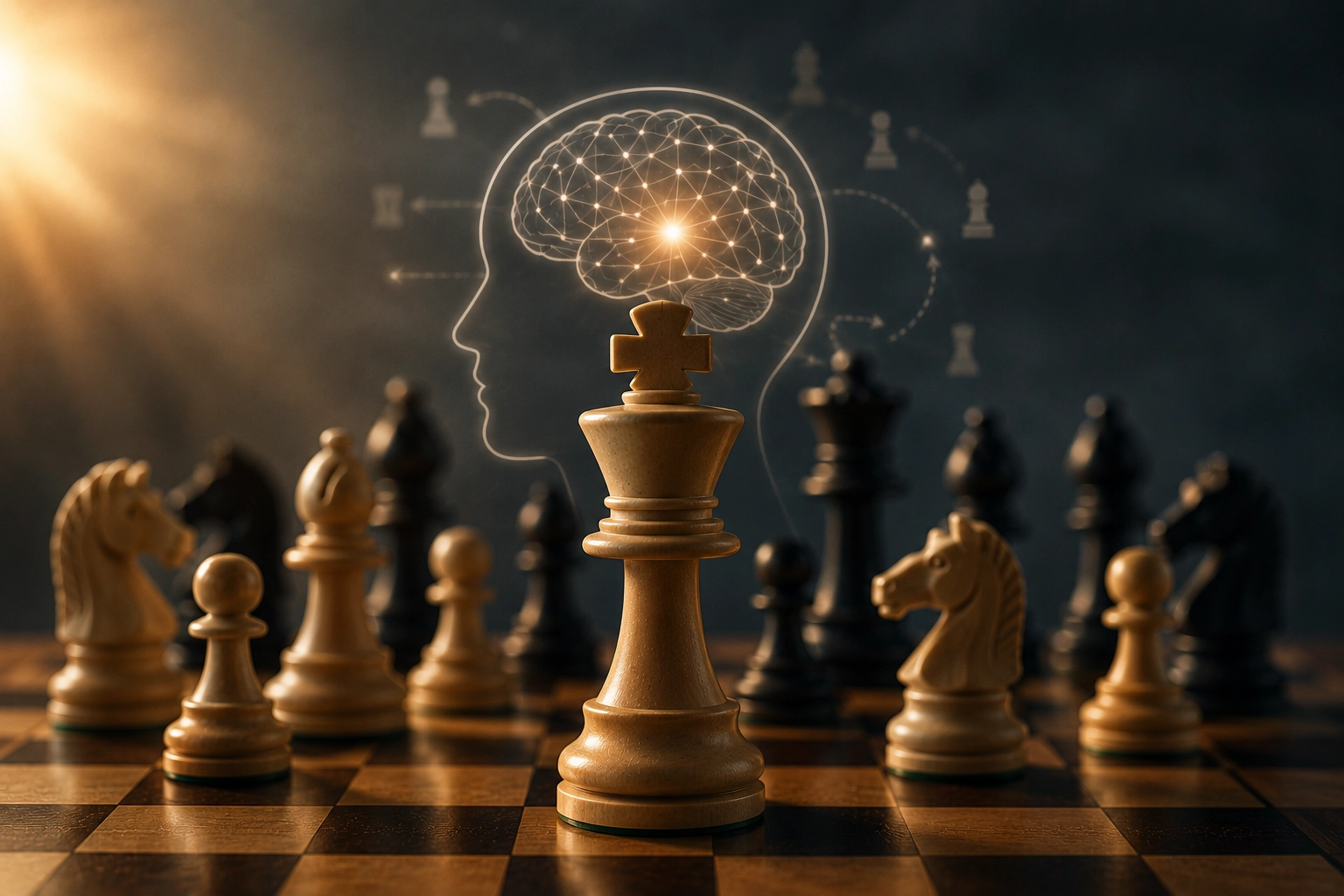
An experienced player doesn’t look at each piece individually. They recognize entire configurations—structures they’ve seen before.
Over time, these positions are stored as chunks of information.
When something similar appears in a game, the brain picks it up almost instantly. There’s no need to start from scratch.
That’s why some moves seem to appear without deep calculation. In reality, they come from years of accumulated pattern recognition.
Intuition isn’t magic
From the outside, many decisions look intuitive.
A player studies the board for a moment and produces a brilliant move, almost effortlessly.
But that intuition isn’t mysterious.
It’s compressed experience.
Every mistake, every game, every analysis leaves a trace. Over time, the brain uses all that stored knowledge without needing a slow, conscious process.
What looks like instinct is actually automated learning.
When experience breaks down
There’s a detail that often goes unnoticed.
When players are shown random positions—without meaningful structure—the advantage of strong players almost disappears.
Their performance becomes much closer to that of beginners.
This is important.
It shows that their ability isn’t about seeing “further” in general. It’s about recognizing meaningful patterns.
Without that structure, their edge fades.
The key question: natural talent or training?
This is where the debate becomes more complex.
Why do some people develop this ability faster than others?
Science doesn’t offer a single answer, but it does provide clues.
There are natural differences in memory, attention, and processing speed. These can influence how easily someone learns chess.
Some people may absorb patterns faster. Or maintain focus for longer periods.
But that’s only part of the story.
Intensive training plays a massive role. Repeated exposure to positions, deep analysis, and constant practice are decisive factors.
Most experts agree that the ability to spot “impossible moves” is largely built over time.
Talent might accelerate the process—but it doesn’t replace the work.
Thinking less, understanding more
Another surprising insight: the best players don’t always think more.
Sometimes, they think better.
They eliminate irrelevant options. They go straight to the core ideas. They avoid wasting energy on lines that don’t matter.
This doesn’t just improve performance. It also reduces mental fatigue.
At a high level, chess isn’t about brute force thinking. It’s about efficiency.
A new way of seeing
With time, the way players look at the board changes.
What once felt chaotic starts to make sense. Pieces seem connected. Weaknesses become visible.
This transformation doesn’t happen overnight.
It’s gradual. Quiet. And often unnoticed until the difference becomes clear.
That’s when those “impossible” moves begin to appear.
The final move
The explanation may not be as mystical as it seems.
There’s no hidden gift reserved for a few. No secret formula.
What there is, is a brain that learns to see better.
And that changes everything.
Because then the question is no longer who can do it—but how far you’re willing to go to start seeing it too.