
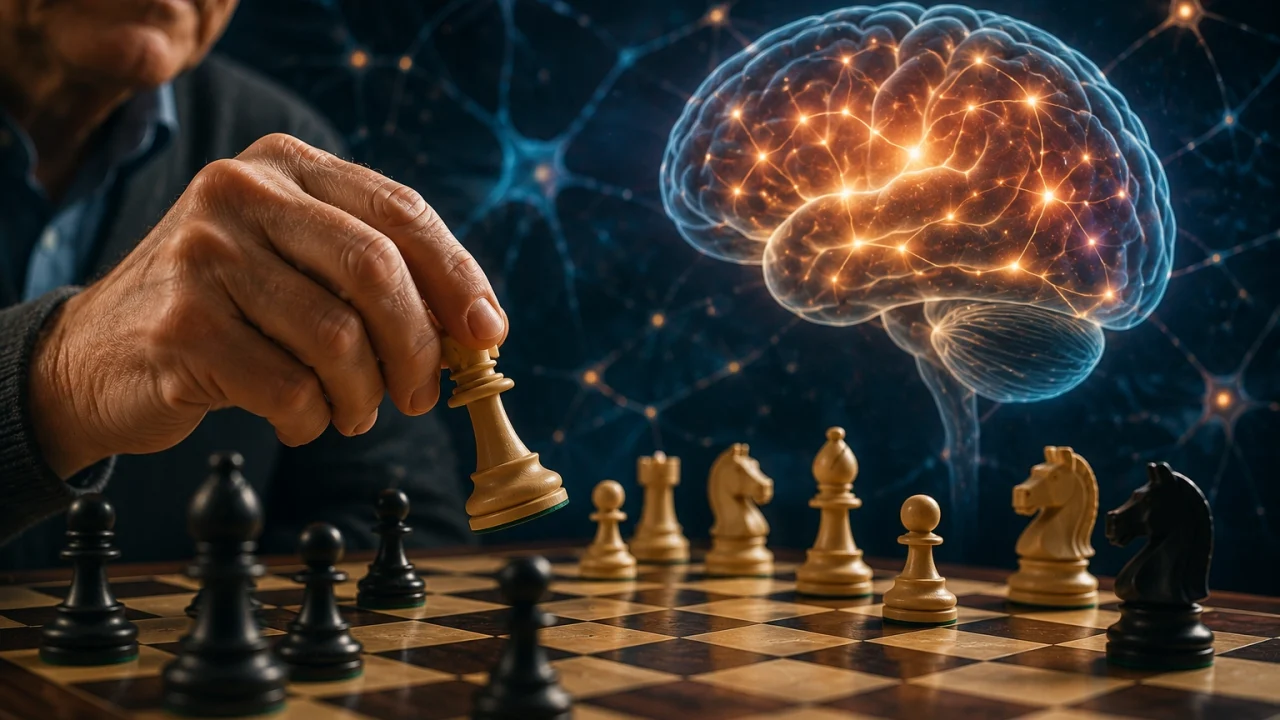
Can you train your brain the same way you train your muscles? More and more research suggests that keeping the mind active plays an important role as we grow older. Among the activities that continue to attract scientific and educational interest, one has stood the test of time for centuries: chess.
Far more than a strategy game, chess constantly challenges the brain. Every move requires attention, memory, planning, and adaptation. That may explain why it continues to appear in schools, cognitive stimulation programs, and educational initiatives for people of all ages.
The real question isn’t whether chess can make someone a genius. It’s why a game that is more than a thousand years old is still regarded as one of the most complete mental workouts ever created.
Every game presents a new challenge
Unlike many repetitive activities, no two chess games are ever exactly the same.
Every position presents a different problem.
Every opponent demands a new strategy.
Every decision requires weighing multiple possibilities before making a move.
That keeps the brain constantly engaged.
There is no autopilot.
Each move forces players to think again from scratch.
A unique combination of mental skills
A single chess game activates several cognitive abilities simultaneously.
Attention helps players follow the position.
Memory allows them to recognize familiar patterns.
Planning is essential for building long-term strategies.
Adaptability becomes critical whenever the opponent changes the course of the game.
Very few activities bring together so many mental processes at once.
Learning to think before acting
Modern life encourages quick decisions.
Instant messages.
Constant notifications.
Immediate responses.
Chess demands the opposite.
It encourages players to slow down.
Analyze.
Evaluate risks.
Accept that impulsive decisions often carry consequences.
That process turns every game into an exercise in thoughtful decision-making.
Improvement begins with mistakes
One of chess’s greatest strengths is how clearly it exposes mistakes.
When a move doesn’t work, the reason often becomes obvious just a few moves later.
That creates an ideal learning environment.
Players review what happened.
Understand the cause.
And try to avoid making the same mistake again.
This continuous cycle of trial, analysis, and correction keeps the brain actively engaged.
The key question: is it all about natural talent?
Many people believe that only highly intelligent individuals truly benefit from chess.
The available evidence suggests otherwise.
Although everyone learns at a different pace, consistent practice appears to play a much greater role than natural ability alone.
Research into learning shows that the brain continually adapts as it gains new experiences.
Over time, recognizing patterns becomes faster.
Decisions require less mental effort.
Problems that once seemed impossible gradually become manageable.
That doesn’t mean chess can stop aging or replace medical treatments.
But it does highlight the brain’s remarkable ability to continue learning when faced with meaningful challenges.
Much more than memorizing openings
Many people assume that strong chess simply comes from memorizing opening theory.
In reality, the game demands much more.
Players must constantly interpret unfamiliar situations.
Adapt.
Improvise.
Abandon one plan and create another when the position changes.
It is precisely this combination of memory, reasoning, creativity, and flexibility that makes every game such a powerful mental exercise.
A game for every stage of life
One of chess’s greatest strengths is its accessibility.
People can begin learning as children.
Continue playing throughout adulthood.
And enjoy it well into later life.
It requires no exceptional physical condition.
No shared language.
No special environment.
Only a chessboard, a set of pieces, and the willingness to think.
That is why chess continues to play a role in schools, community organizations, clubs, and cognitive stimulation programs around the world.
Growing interest around the world
The increasing fascination with brain health has also contributed to chess’s popularity.
More people are searching for activities that combine entertainment with intellectual challenge.
Chess offers both.
It is enjoyable while constantly presenting new problems to solve.
That combination continues attracting new players while encouraging former enthusiasts to rediscover the game years later.
The final move
Perhaps the greatest value of chess isn’t winning games.
Or memorizing opening lines.
Or finding brilliant tactical combinations.
Perhaps its greatest strength lies somewhere much simpler.
It teaches us to think.
To pause before making decisions.
To learn from mistakes.
And to remember that the human brain, like any other ability, continues to develop when it is challenged.
That may be the real reason why, after more than a thousand years, chess remains one of the most fascinating ways to keep the mind active.


