
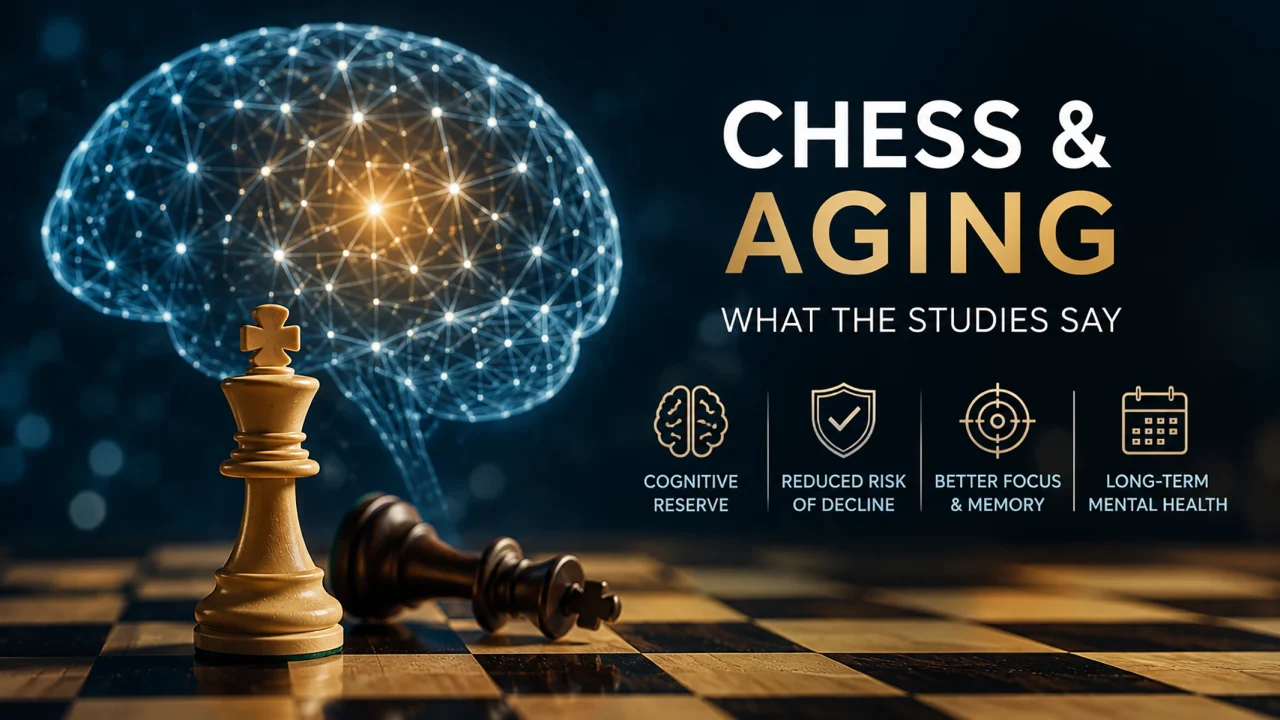
Some people continue playing chess well into their 80s and still manage to calculate variations, recognize patterns, and make complex decisions with surprising speed. That has led scientists to ask a fascinating question: could chess actually help the brain age differently?
The brain changes over time
Aging naturally affects the brain.
Mental speed tends to slow down. Certain memory and attention functions become less efficient. Processing new information can take longer.
That happens even in healthy people.
But researchers have noticed something interesting over the years: not all brains age in the same way.
Some individuals maintain strong cognitive abilities far longer than others. And one factor that repeatedly appears is lifelong mental stimulation.
Chess as cognitive exercise
This is where chess enters the conversation.
A single game activates multiple mental processes at once: concentration, memory, planning, calculation, and decision-making under pressure.
It’s not passive entertainment.
The brain must constantly adapt, evaluate threats, anticipate outcomes, and correct mistakes in real time.
That type of sustained mental effort appears to function as a form of cognitive training.
The idea of “cognitive reserve”
One of the most discussed concepts in this field is cognitive reserve.
The theory suggests that intellectually demanding activities may help the brain develop additional mental resources to cope with age-related decline.
Reading, learning languages, playing instruments, and solving complex problems are often included in that category.
Chess is too.
The idea isn’t that the game magically protects the brain. Rather, it may help keep certain mental networks active for longer periods of time.
What the studies suggest
Several studies have found associations between regular cognitive activity and a lower risk of mental decline later in life.
That doesn’t mean chess prevents neurodegenerative diseases. Scientists remain very cautious about making those claims.
But there is growing agreement on one important point: keeping the brain mentally active appears beneficial.
Chess stands out because it combines multiple demands simultaneously—sustained attention, working memory, strategic analysis, and emotional control.
Very few activities engage so many processes at once.
The key question: does the benefit depend on talent?
This is where the discussion becomes especially interesting.
Does chess only help people who already have strong cognitive abilities? Or can anyone benefit from playing?
Experts believe training plays a major role.
You don’t need to be a grandmaster to stimulate the brain. In fact, much of the potential benefit seems to come from the process of learning and adapting.
Solving problems, recognizing patterns, and facing new situations forces the brain to stay engaged.
That applies even to casual players.
Of course, people are different. Some learn faster or enjoy mental challenges more naturally.
But the cognitive impact doesn’t appear to depend entirely on talent.
The emotional factor people rarely mention
There’s another side to this that receives less attention.
Chess doesn’t only challenge cognitive functions. It can also influence emotional well-being.
Maintaining mental routines, competing socially, or simply having an intellectual challenge can create a sense of purpose and motivation.
And that matters during aging.
Because mental health and cognitive activity are far more connected than many people once believed.
Thinking under pressure
Another fascinating aspect of chess is that it forces players to make decisions in uncertain situations.
That requires mental flexibility.
The brain isn’t simply recalling information. It must interpret, reorganize, and react to constantly changing conditions.
This kind of exercise may become especially valuable later in life, when many people unintentionally reduce mentally demanding activities.
What chess cannot do
Researchers are careful to emphasize something important.
Chess is not a guarantee against cognitive aging. It’s not a magic formula for maintaining a perfect mind.
Brain health depends on many factors, including sleep, physical exercise, nutrition, social relationships, and genetics.
Still, chess appears to offer something meaningful: it keeps the brain challenged.
And in a world where so much entertainment has become passive, that may matter more than it seems.
The final move
Perhaps the most fascinating thing about chess isn’t who wins the game.
Perhaps it’s the fact that the game forces the brain to keep adapting, even after decades.
Thinking, deciding, correcting mistakes, and starting again.
And maybe that’s one of the most important lessons about mental aging: never letting the mind stop playing.


