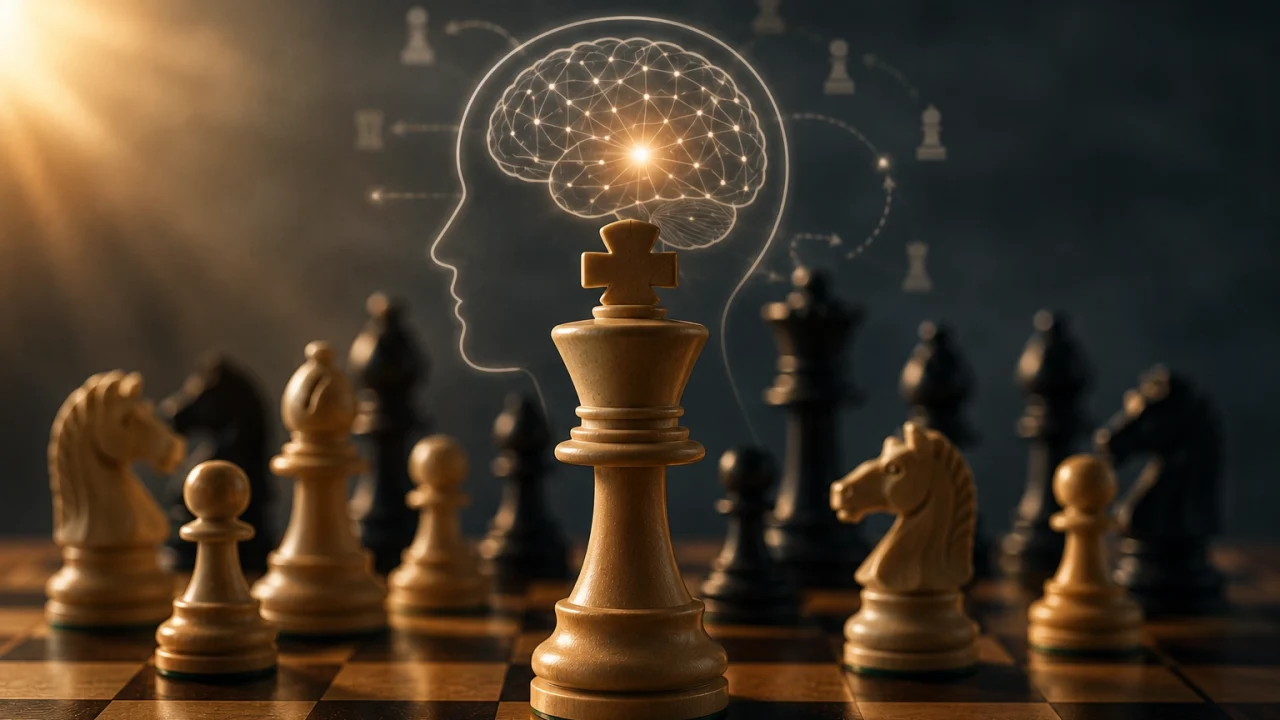
There’s something unusual about chess. The longer you spend with it, the less it feels like a simple game.
At first, it’s just pieces, rules, and the goal of winning. But over time, something changes. You begin to notice that every decision has consequences, that mistakes rarely happen by accident, and that many of the skills used over the board apply far beyond it.
Perhaps that’s why chess has survived for more than a thousand years. Because while it may be played as a sport or a pastime, for millions of people it represents something much deeper.
Utiliza las teclas de flecha arriba y abajo para cambiar el tamaño del panel de la caja meta.
More than moving pieces
On the surface, chess seems straightforward.
Move the pieces. Protect your king. Checkmate your opponent.
But it only takes a few games to realize that the real battle happens inside the mind.
Every position demands decisions.
Every move requires choices.
Every mistake offers a lesson.
That makes chess very different from most traditional games.
There are no dice.
No hidden cards.
No random events deciding the outcome.
The consequences of every decision remain visible on the board.
A laboratory for the brain
Few activities require so many mental functions at once.
Players must focus.
Recognize patterns.
Plan ahead.
Predict responses.
Evaluate risk.
And constantly adapt to changing situations.
All of this happens during a single game.
That’s one reason chess has attracted the attention of psychologists, educators, and researchers for decades.
Not because it’s a magical solution.
But because it engages multiple cognitive processes simultaneously.
A constant lesson in mistakes
One of the most valuable aspects of chess is how clearly it exposes errors.
Mistakes are often punished quickly.
But they also create immediate learning opportunities.
When a decision turns out to be wrong, the consequences usually become visible within a few moves.
That creates a powerful feedback loop.
Players can review what happened, understand the mistake, and adjust their thinking for future games.
Few activities demonstrate the connection between decisions and outcomes so clearly.
Patience can be trained
Modern life moves fast.
Answers arrive instantly.
Distractions are everywhere.
Chess works differently.
It forces players to slow down.
To think.
To evaluate.
To wait.
Sometimes the best move isn’t the most exciting one.
It’s simply the most patient.
And the ability to resist impulsive decisions becomes increasingly valuable both on and off the board.
The key question: talent or training?
This is where one of the most interesting debates begins.
Why do some people improve so quickly while others take much longer?
The answer appears to lie somewhere between natural ability and experience.
People are different.
Some recognize patterns more easily.
Others possess stronger concentration or working memory.
Those factors matter.
But modern research suggests something equally important.
Experience fundamentally changes how people think.
Strong players don’t always calculate more moves.
Very often, they recognize familiar structures they have encountered thousands of times before.
That means much of what looks like talent is actually accumulated experience.
And that idea is fascinating.
Because it shows how adaptable the human brain can be.
A school for decision-making
Beyond competition, chess teaches a crucial life skill.
Making decisions under uncertainty.
No player knows exactly what will happen next.
No one can calculate every possibility.
Eventually, a decision must be made.
And the consequences must be accepted.
That situation closely resembles many real-life challenges.
Perhaps that’s why so many people find lessons in chess that extend far beyond the result of a single game.
A universal language
Another reason chess transcends the definition of a game is its ability to connect people.
Language doesn’t matter.
Age doesn’t matter.
Nationality doesn’t matter.
Two strangers can sit across from each other and communicate perfectly through their moves.
Very few activities possess that kind of universality.
And perhaps that is why chess continues to grow around the world even in the digital age.
Closer to art than many realize
Some people view chess as a science.
Others see it as a sport.
Many consider it an art form.
And perhaps all of them are right.
A great game can combine precise calculation with creativity.
Logic with imagination.
Discipline with inspiration.
It can produce ideas that surprise even those who have studied the game for years.
That combination remains one of chess’s greatest attractions.
The final move
Perhaps the best way to understand chess is to stop thinking of it as merely a game.
Because the board does not simply display moving pieces.
It reveals decisions.
Mistakes.
Patience.
Adaptation.
Creativity.
And different ways of approaching problems.
Maybe that is why, after more than a millennium of history, chess continues to inspire the same fascination.
Because in the end, every game reveals more than who wins.
It reveals how we think.
Utiliza las teclas de flecha arriba y abajo para cambiar el tamaño del panel de la caja meta.