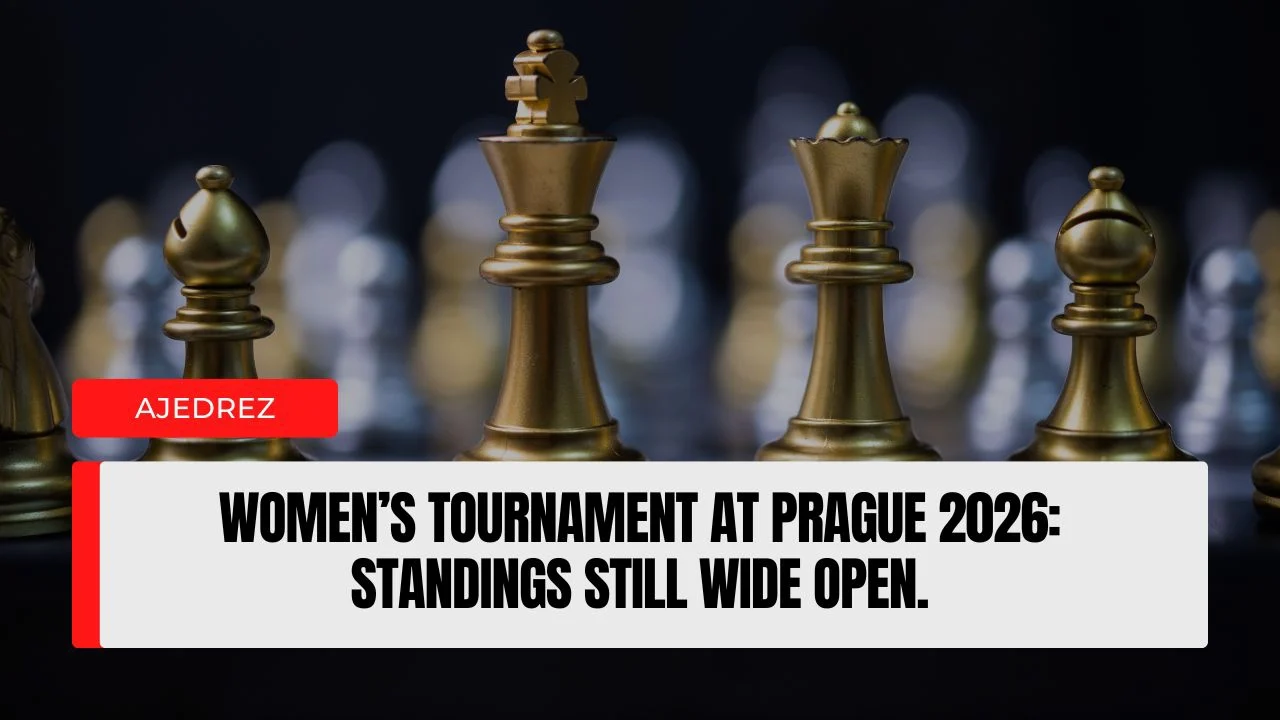
The women’s tournament at the 2026 Prague Chess Festival continues to establish itself as one of the most competitive sections of the event, bringing together internationally experienced players in a tightly contested competition. As the rounds progress, the standings remain extremely close, with several participants still in contention for the top positions.
Games played so far have highlighted the strong technical level of the field, featuring deep opening preparation, complex middlegame battles and demanding endgames. The competitive balance among the participants has prevented any single player from gaining a decisive lead, ensuring that each round carries significant importance.
This combination of strategic depth and competitive equality has kept the tournament open and unpredictable as it approaches its decisive stages.
A women’s tournament that strengthens the Prague Festival’s role as an international chess platform
In recent years, the Prague Chess Festival has become one of the most prominent events on the European chess calendar thanks to its structure, which includes several high-level competitions within the same festival. The women’s tournament forms an important part of this structure and provides participants with the opportunity to compete in a professional and demanding environment.
The presence of players with international experience raises the overall strength of the field and creates balanced encounters from the very beginning of the event. As a result, games frequently evolve into strategically rich battles that require sustained accuracy and deep positional understanding.
Beyond its sporting significance, the tournament also contributes to the continued development and visibility of women’s chess on the international stage.
Strategically rich games have shaped the development of the competition
The games played in the women’s tournament have been marked by notable strategic complexity and a wide range of opening approaches. From the early stages of play, many positions have developed into dynamic structures where initiative and piece coordination played key roles.
In several encounters, the middlegame proved decisive. Long positional maneuvers, carefully timed pawn breaks and well-calculated tactical ideas shaped the course of games that remained balanced for extended periods.
When the struggle transitioned into technical endgames, accuracy became critical. King activity, effective piece coordination and careful pawn structure management often determined whether small advantages could be converted into full points.
A tightly packed standings table keeps multiple players in contention
One of the defining characteristics of the women’s tournament at the 2026 Prague Chess Festival is the close competition among participants. The standings have remained compressed throughout much of the event, with several players separated by only minimal differences.
This competitive balance significantly increases the importance of each round. In closed tournaments where every participant faces all the others, the results of a single day can produce substantial shifts in the table.
The proximity among the leading contenders suggests that the final outcome will likely be decided during the closing rounds.
The tournament’s impact on international ratings and the broader development of women’s chess
The women’s competition at the Prague Chess Festival is played under the official regulations of FIDE, meaning that every result directly influences the international ratings of the players involved.
This adds an additional layer of importance to each game, as rating performance remains a key measure of competitive strength in the global chess circuit.
Participation in tournaments of this caliber allows players to test themselves against strong opposition while continuing to develop their competitive experience in a highly professional setting.
A championship heading toward a decisive finish marked by intense competition
As the tournament approaches its final rounds, the battle for the leading positions continues to intensify. The narrow margins in the standings ensure that every remaining game has the potential to alter the final classification.
In such a tightly contested event, consistency becomes a decisive factor. Players capable of maintaining stability in complex positions and capitalizing on key opportunities will be best positioned to finish at the top.
The women’s tournament at the 2026 Prague Chess Festival therefore moves toward its concluding phase with the standings still wide open and with the expectation that the final rounds will ultimately determine the champion in a competition defined by balance and high-quality play.