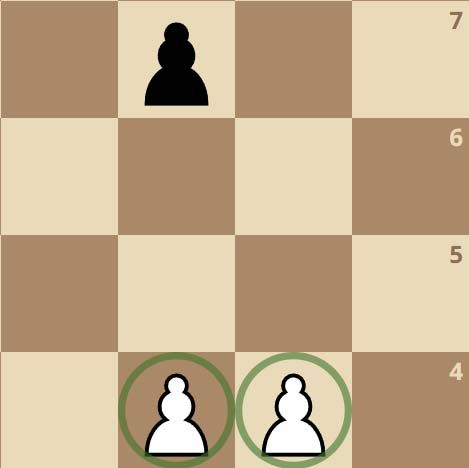

Doubled pawns are another key concept in chess strategy that every player should understand and manage properly. Although often considered a weakness, doubled pawns can present tactical and strategic opportunities in certain situations.
In this article, we’ll explore what doubled pawns are, how they are formed, their advantages and disadvantages, and how to play both with them and against them.
What Is a Doubled Pawn?
A doubled pawn is a situation where two pawns of the same player occupy the same file, one directly in front of the other. This pawn structure is considered a weakness because the pawns cannot support each other, which makes them harder to defend. Doubled pawns typically arise when two pawns capture into the same file, leaving a player with a less flexible structure and more vulnerable to enemy attacks.
Characteristics of a Doubled Pawn
- Pawns on the same file: Doubled pawns are always stacked on a single file, meaning one is directly ahead of the other.
- Lack of mobility: Doubled pawns cannot advance as a unit, which limits their ability to occupy the center and control key squares.
- Defensive difficulties: Doubled pawns are easier to attack, as they lack strong mutual defense.
How a Doubled Pawn Is Formed
Doubled pawns can arise in several ways, typically due to exchanges or poor strategic decisions. Below are some of the most common scenarios:
1. Doubled Pawn by Capture
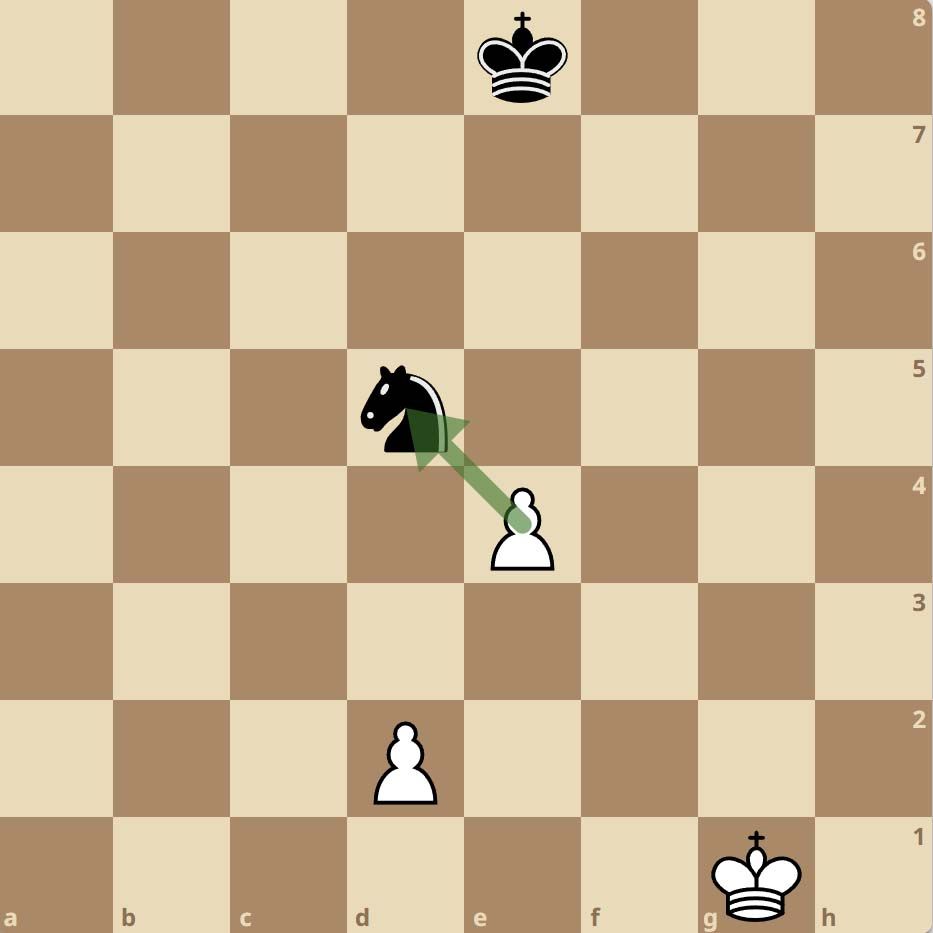
This is the most common case and occurs when a pawn captures diagonally and lands on the same file as another friendly pawn.
Example:
- White pawns on d2 and e4.
- An enemy piece is on d5.
- The pawn on e4 captures the piece on d5.
- Now the white pawns are doubled on the d-file: d2 and d5.
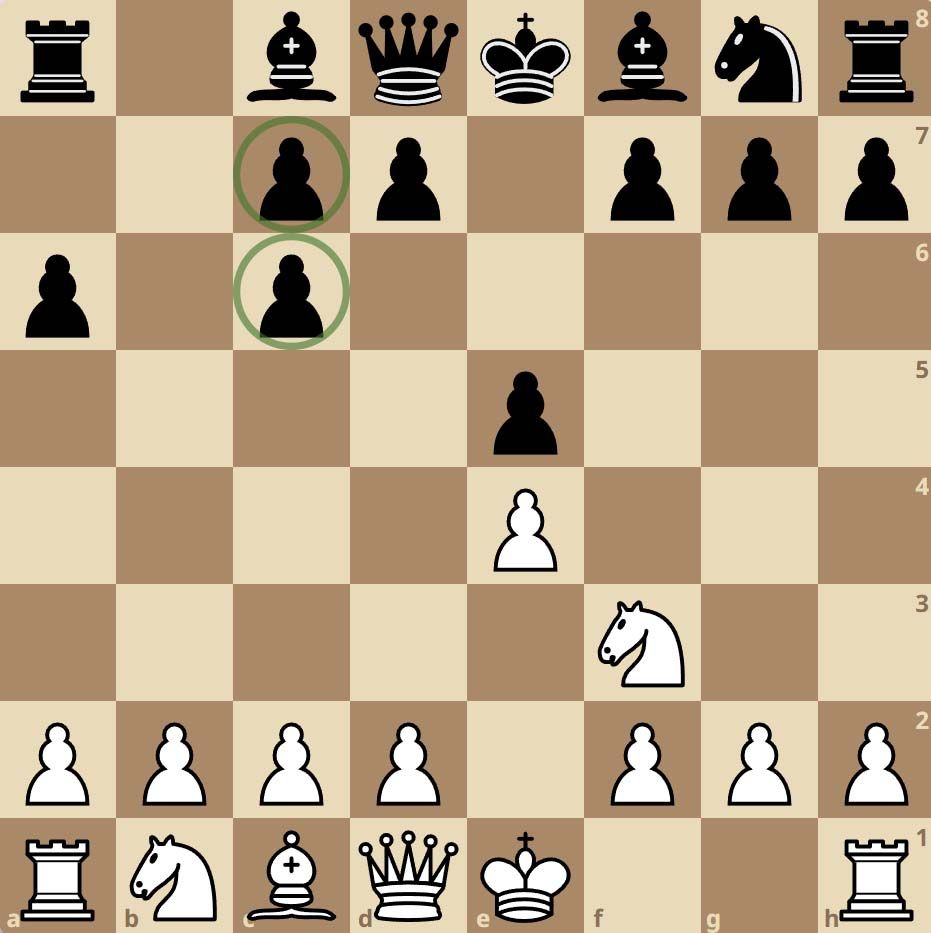
2. Doubled Pawn After Piece Exchange
When minor pieces are exchanged on the board, a pawn might recapture on the same file where another friendly pawn is already located.
Example:
- A white knight is on c3, and a black knight on d5.
- White plays Nxd5.
- Black recaptures with the pawn on e6: exd5.
- Result: Black has doubled pawns on the d-file: d5 and d6.

3. Doubled Pawns After Kingside Attacks
This happens when a player captures a piece defending the castled king, and a flank pawn (on f, g, or h files) recaptures, creating a doubled pawn.
Example:
- On the kingside, Black has pawns on f7, g7, and h7 (after short castling).
- A white piece (e.g., a knight on g5) captures on f6.
- The black pawn on g7 recaptures: gxf6.
- Result: Black has doubled pawns on f6 and f7.
Learn more about castling here

Disadvantages of Doubled Pawns
The main downside of doubled pawns is that they create a vulnerable structure that can be easily targeted by the opponent. Some key disadvantages include:
1. Vulnerability to Attacks
Doubled pawns are easy targets for enemy pieces, especially rooks and queens, which can aim down open files where the doubled pawns sit. Additionally, the top pawn in the stack cannot be defended by the pawn behind it, making it susceptible to capture.
2. Difficulty Advancing
A key issue with doubled pawns is that they struggle to advance. Since they are stacked on the same file, they cannot move forward as a unified force, limiting their control of the center and ability to gain space.
3. Blocking Other Pieces
Doubled pawns can also block other pieces that would otherwise be more active on the board. With pawns stacked on a file, pieces like knights and rooks may be forced into less effective squares or become passive.
How to Play with Doubled Pawns
If you end up with a doubled pawn structure, it’s essential to know how to manage it to minimize its drawbacks and capitalize on potential opportunities. The key is often to seek counterplay, as in many cases these pawns become targets. However, strong piece activity may compensate for the structural weakness.
Conclusion
Doubled pawns are a strategic weakness in chess, as we’ve seen. However, with proper handling, even a player with doubled pawns can exploit the opportunities they offer and use active piece play to compensate. The key lies in adapting to the specific board situation and making well-informed decisions.
To learn more about chess strategy, or if you want to improve other areas of your game, check out our blog entries, completely free. 😉